Skip to content
Estate Affidavit Guide

Wisconsin Transfer by Affidavit

If a bank told you an account is frozen and didn't explain what that actually means, you're not stuck, and you're not the only one this has happened to. A probate attorney would typically charge $1,500–$4,200+ to walk you through exactly what Wisconsin law already lets you do yourself. This guide is $37, one-time, and covers the same ground — the eligibility rule, the official form, and what to say if a bank or clerk pushes back.

Wisconsin's Transfer by Affidavit — Wis. Stat. § 867.03, Wisconsin's version of a small estate affidavit — lets an heir, a trustee of the decedent's revocable trust, the decedent's guardian, or the person named in the will collect the decedent's property without probate when everything subject to administration in Wisconsin is worth $50,000 or less, gross. It is sworn before a notary and given to each bank or other holder; for real estate it is recorded with the register of deeds after 30 days' notice to the heirs. There is no general waiting period after death. This is informational only, written by researchers, not attorneys.

Last reviewed

Wisconsin has more than one probate-avoidance mechanism. See the Termination of Decedent's Interest guide instead →

Why this guide exists

The state's own form is usually clear about the fields and silent about the process. Families commonly report a bank branch insisting on court-issued Letters of Administration that the small estate statute doesn't actually require, and each extra trip lands in the same weeks as the funeral. Closing that gap — between a downloaded form and an asset holder who actually releases the property — is the whole reason this guide exists. Written under the pen name ; not an attorney.

Splitting up the estate with someone else? Send them this page before you start.

Email This

Why timing matters: Wisconsin has no waiting period, so the timing is up to you: if the decedent or the spouse ever received Medicaid or long-term care, no bank should release anything until it sees the certified-mail receipt showing the state's Estate Recovery Program got its copy — and for real estate, nothing can be recorded until 30 days after the heirs get notice. Start both clocks the day the affidavit is signed. Miss the window and the estate is generally pushed into full probate instead — a probate attorney typically charges $1,500–$4,200+ for work this guide is built to help you avoid.

The Wisconsin $50,000 Transfer by Affidavit cap

Filing Transfer by Affidavit in Wisconsin starts with one number — the statutory cap. The estate, measured the way the statute measures it, has to be at or under $50,000 (gross value — debts, mortgages and liens are not subtracted — of all the decedent's property subject to administration in Wisconsin, as of the date of death), under Wis. Stat. § 867.03. This is a statutory line, not a judgment call — the court or asset holder either sees the total under the cap or they don't. Transfer by Affidavit is presented directly to the asset holder — no court filing required. Wisconsin's court system no longer maintains a Transfer by Affidavit form; the State Bar of Wisconsin's Real Property, Probate and Trust Section maintains the current form, its heirship and notice addenda, and instructions, free at wisbar.org. See the how-to-file guide below for what the statute itself requires.

How to file, step by step

  1. 1

    List what the decedent owned that would go through probate in Wisconsin, at gross value

    Total everything the decedent owned in their own name that would be subject to administration in Wisconsin, valued as of the date of death, without subtracting mortgages, loans or other debts. Leave out property that passed to someone else automatically at death — joint ownership with survivorship, payable-on-death or transfer-on-death designations — but include property a beneficiary designation sends to the estate. Compare the total with $50,000.

  2. 2

    Confirm the capacity you will sign in

    You must be an heir, a trustee of the decedent's revocable trust, the decedent's guardian at the time of death, or the person named in the will to act as personal representative. If you are named in the will but are not an heir, trustee, or guardian, you cannot take real estate this way, and holders must wait 30 days after receiving your affidavit.

  3. 3

    Find out whether the decedent or the spouse received listed benefits

    The form asks about Medical Assistance/Medicaid, Family Care or Partnership, Community Options Program, the Wisconsin Chronic Disease Program, and care as a patient or inmate of a state or county institution — for the decedent and for any spouse, living or deceased. If any applies, send a copy of the completed affidavit by certified mail, return receipt requested, to the Department of Health Services Estate Recovery Program, P.O. Box 309, Madison, WI 53701-0309, and keep the receipt showing the delivery date.

  4. 4

    Get the current State Bar form set, not an old county copy

    Download the Transfer by Affidavit, the Affidavit of Heirship addendum, the Affidavit of Service or Waiver of Notice, and the instructions from the State Bar of Wisconsin. Each current page is footer-dated (7.17.19). A copy marked "PR-1831, 04/07" is the obsolete court version. View source →

  5. 5

    Complete the affidavit

    The form asks for the decedent's birth and death dates, county and state of domicile and address; your capacity; the total gross value of property subject to administration in Wisconsin; a description of every item to be transferred (legal description and tax parcel number for land; institution and account type for accounts); any spouse, living or deceased, married or divorced; and the benefits table. It ends with your acknowledgment that you must pay the decedent's debts in the order Wis. Stat. § 859.25 sets and pass the rest to those entitled under the will or intestacy law.

  6. 6

    For real estate, give the heirs 30 days' notice first

    Complete the Affidavit of Heirship addendum. At least 30 days before recording, send each heir a copy of the affidavit and notice that you intend to record it, by certified mail or personal service — or get signed waivers — and complete the Affidavit of Service or Waiver of Notice.

  7. 7

    Sign under oath before a notary

    The form is subscribed and sworn before a notary public (or court officer). Nothing is filed with a court.

  8. 8

    Present it to each holder

    Give the affidavit, with the certified-mail receipt attached if notice was required, to each bank, credit union, brokerage or other holder. Section 867.03 does not list a death certificate as an attachment; ask each holder what it needs before you go.

  9. 9

    Record it for real estate

    Record a certified copy or duplicate original with the register of deeds in each county where the land is located, with the heir-notice proof, the DHS receipt if required, the legal description, and an electronic real estate transfer return. The recording fee is $30. Recording is what transfers the real estate to you.

  10. 10

    Use WisDOT's form for a vehicle

    Transfer a car on WisDOT form MV2300 with the title and form MV1, not on the affidavit. View source →

  11. 11

    Pay debts, then distribute

    By accepting the property you take on a duty to pay the decedent's obligations in the priority Wis. Stat. § 859.25 sets and distribute the balance under the will or, without one, Wisconsin's intestacy rules. The property remains subject to any Estate Recovery Program claim.

Wisconsin has two distinct filings for passing property after a death without full probate — and which one applies depends on how the property was owned, not on a shared dollar threshold.

  • Property the decedent owned alone, going through probate, worth $50,000 or less gross in total: the Transfer by Affidavit (Wis. Stat. § 867.03) is the filing — a sworn affidavit given to each bank or other holder, or recorded with the register of deeds for real estate. There is no waiting period after death, but the state must be notified first if the decedent or the spouse received Medicaid or long-term care benefits.
  • Property that already passed to a survivor at death — joint tenancy, survivorship marital property, a transfer-on-death deed, a life estate: the Termination of Decedent’s Interest (Wis. Stat. §§ 867.045, 867.046) is the filing — a standard form recorded with the county register of deeds to clear the deceased owner’s name from the record. It has no dollar cap.

Many Wisconsin families need both: a house held in joint tenancy, and a small account in the decedent’s name alone. Probate property worth more than $50,000 gross is neither of these: Wisconsin’s court procedures apply.

This page, and the two guides linked above, are informational only. They are not legal advice, and they do not draft, file, or individualize any affidavit or form on your behalf. For advice on your specific estate, consult a licensed Wisconsin attorney.

What it actually looks like

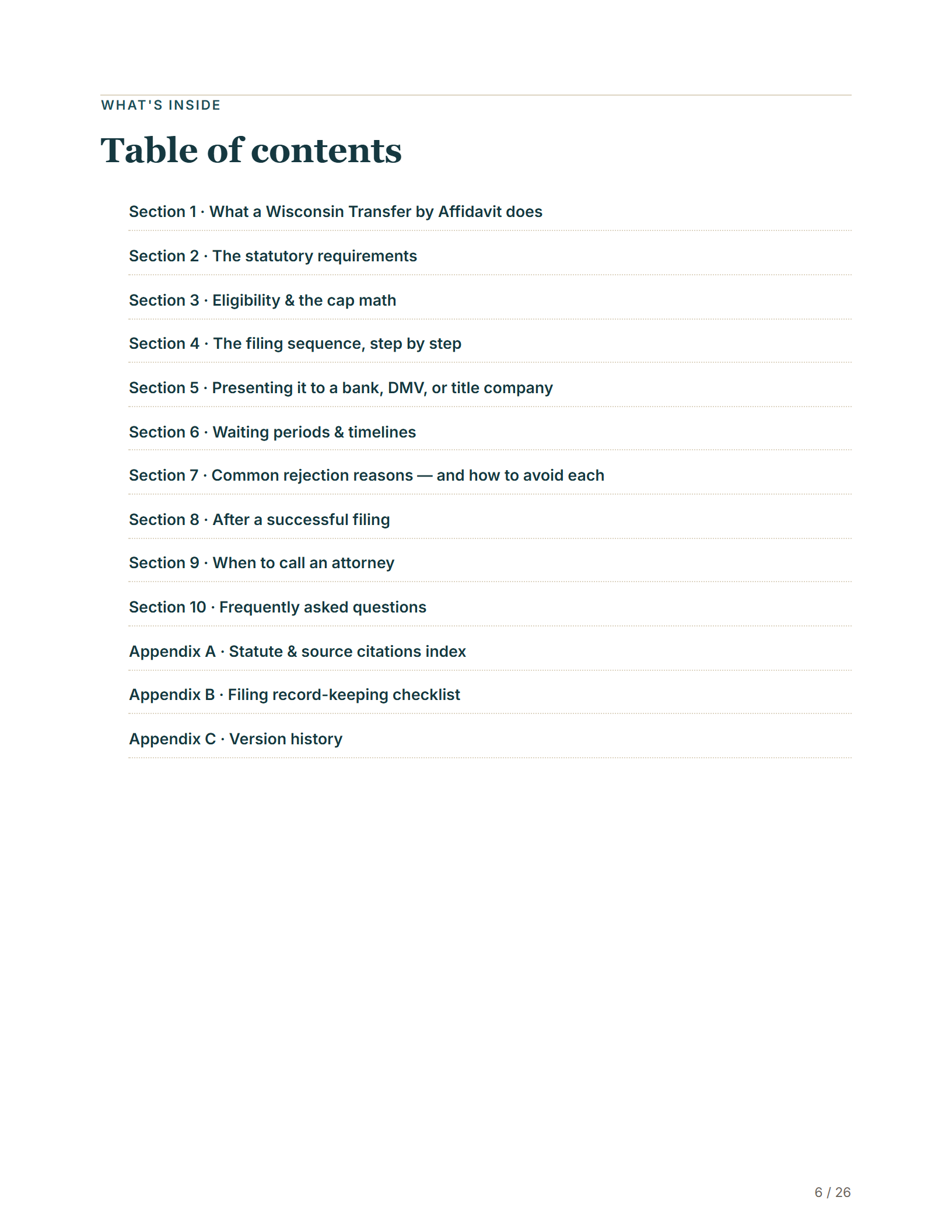
Sample pages from the guide

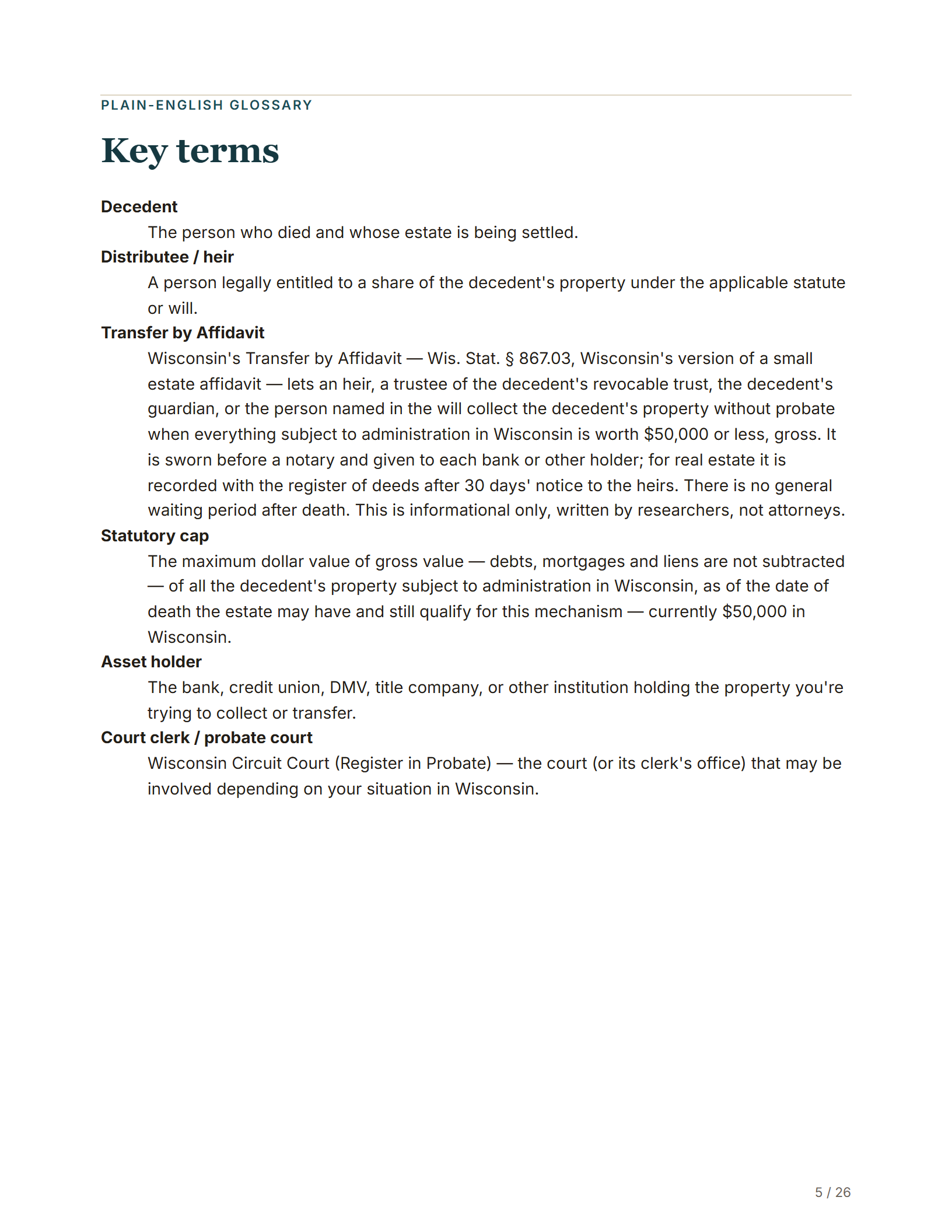
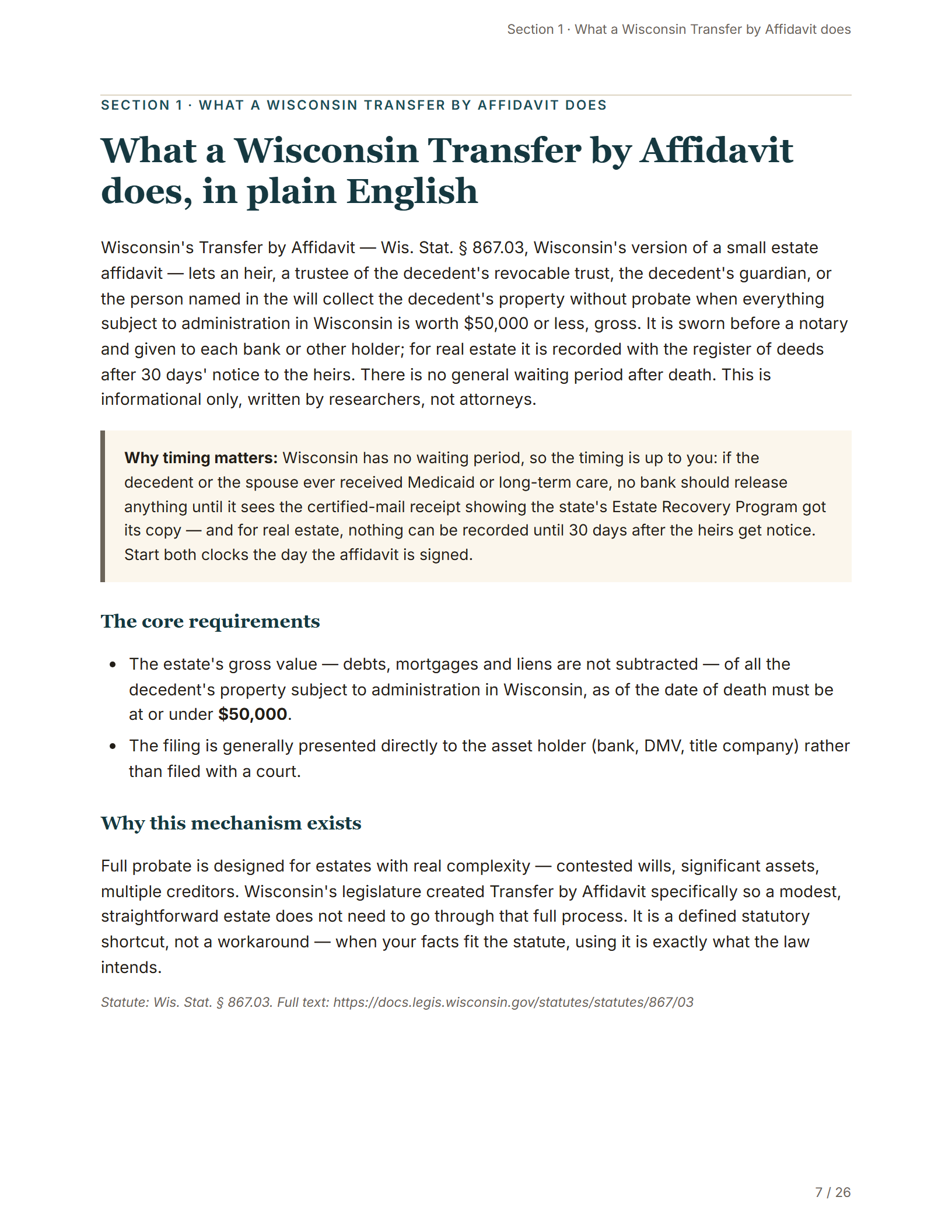
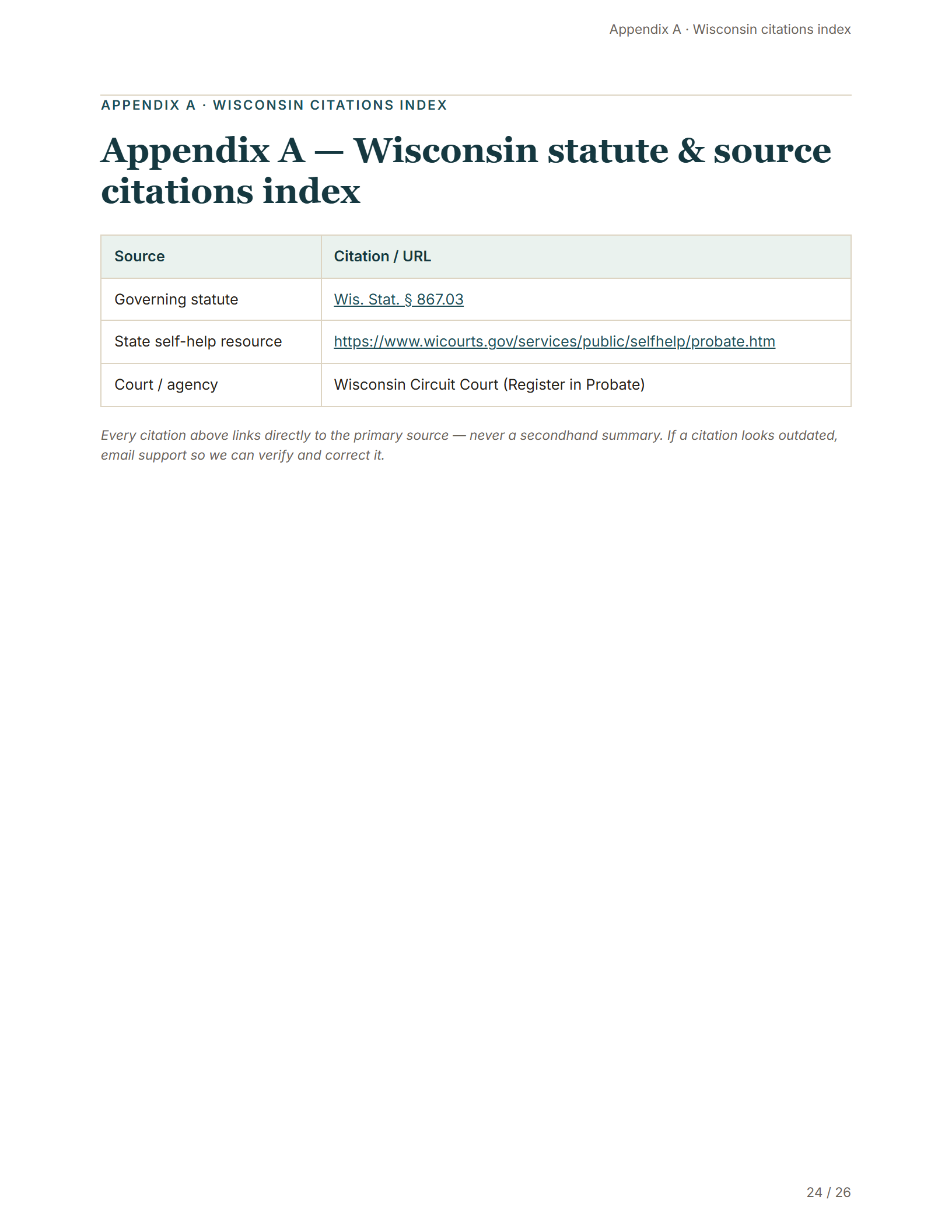
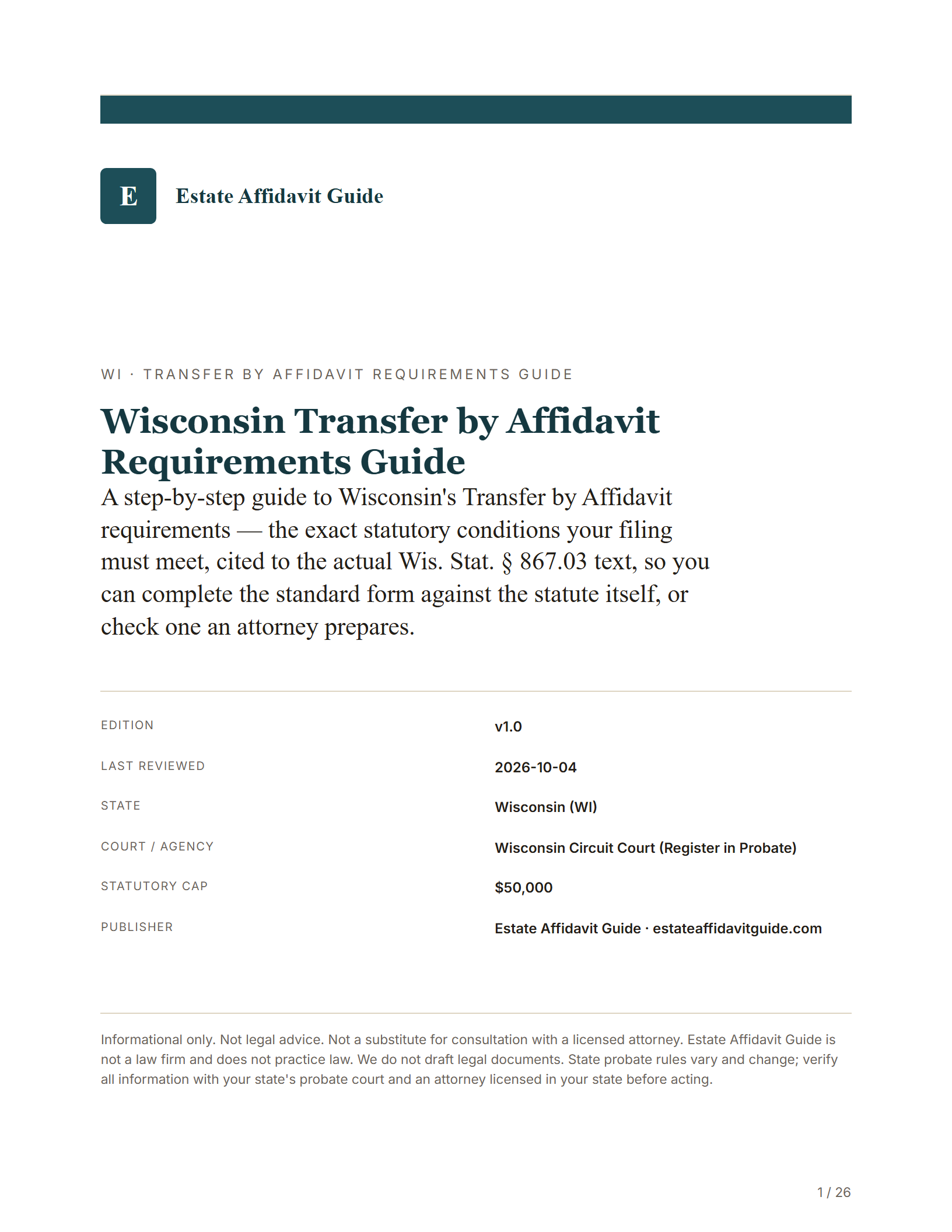
Real pages from the Wisconsin guide PDF. Click any page to enlarge.

Print-friendly, readable on a phone or tablet, and designed to be taken to the bank or clerk. Every operational claim cites the actual statute or official publication.

How this compares

Yes — the standard form Wisconsin families use is free (that's the Free standard form column below), though it isn't issued by the state itself. The $37 is for everything the free form leaves you to work out alone: the eligibility check, the filing sequence, and what to do when a bank, DMV, or clerk pushes back.

This guide Probate attorney Free standard form Doing nothing
Cost $37 $1,500–4,200+ $0 Eventually full probate, if the estate is never settled
Time to filed Same week 2–6 weeks If you can decode it alone Not until you act
Bank/DMV/clerk pushback script Yes Sometimes No n/a
Statute citations Yes n/a n/a n/a
Delivery time Instant download After consult + retainer Instant n/a

Attorney costs reflect typical Wisconsin probate-attorney retainers for this kind of filing.

The most-searched sticking point

What to do when a bank, DMV, or clerk pushes back

A facially valid filing still gets rejected on the first try more often than it should — usually because front-line staff have never processed one before, not because anything is actually wrong. This is the single biggest gap in every free state resource: none of them tell you what to actually say. The guide's Section 5 gives you the exact script and citation for each of these:

  • Bank or other holder refuses a compliant affidavit and asks for probate papers instead
  • Bank says it cannot release anything until it sees a state notice receipt
  • Bank says it must hold the funds for 30 days
  • Register of deeds will not record the affidavit for real estate
  • DMV turns away the affidavit for a car

Each one has a specific script and statutory citation behind it — not just "you're right, they're wrong," but exactly what to say and what document to hand over. That's in the guide.

If a bank, DMV, title company, or court clerk rejects your filing for a reason traceable to following this guide, you get a full refund.

Email the stated rejection reason to support@estateaffidavitguide.com within 30 days of purchase and we refund the full purchase price within one business day. No phone tag, no forms, no fight. Not covered: an estate that turns out to be over the dollar limit, a dispute among heirs, or a missing document unrelated to the filing itself. Changed your mind for any other reason? You have 7 days, no questions asked. Full refund policy.

Avoid these

5 common reasons filings get rejected

The property subject to administration is worth more than $50,000 gross
The affidavit states the total value of the decedent's property subject to administration in Wisconsin at the date of death, and it may not exceed $50,000 in gross value. Debts, mortgages and liens are not subtracted. Property that passes outside probate — joint ownership with survivorship, a payable-on-death or transfer-on-death designation — is not property subject to administration. — Wis. Stat. § 867.03(1g)(b); State Bar form ¶ 3
The person signing is not in an eligible capacity
Only an heir, a trustee of a revocable trust the decedent created, the person named in the will to act as personal representative, or the person who was the decedent's guardian at death may use the affidavit. A creditor, a friend, or a relative who is not an heir cannot. — Wis. Stat. § 867.03(1g); State Bar form ¶ 2
The state's Estate Recovery Program was not notified first
If the decedent or the decedent's spouse ever received Medical Assistance or the other listed benefits, notice to the Department of Health Services by certified mail, return receipt requested, must come first, and proof of delivery showing the date must be attached. A holder that sees no receipt in that case should not release. — Wis. Stat. § 867.03(1g)(c), (1m); State Bar form ¶ 8
Real estate is involved and the real-estate conditions were not met
A will-named personal representative who is not also an heir, trustee, or guardian cannot take real estate by affidavit, and the heirs must get a copy and notice at least 30 days before the affidavit is recorded with the register of deeds, unless they waive it. — Wis. Stat. § 867.03(1h), (1p), (2m); State Bar form ¶¶ 2, 4, 6
The holder is inside the 30-day hold, or a second affidavit has arrived
When the affiant signs only as the will-named personal representative, the holder must wait 30 days after receiving the affidavit; if another affidavit for the same decedent arrives in that period, the holder may not transfer without a court order. — Wis. Stat. § 867.03(1j)

Before you present the Wisconsin Transfer by Affidavit

Most rejected-on-the-first-try filings are a front-line-staff problem, not an eligibility problem. This free one-pager has what to bring and what to say the first time you hand it to a bank, DMV, or clerk — emailed now. We'll also send a few short follow-ups over the next few weeks (why most pushback is unfamiliarity not law, the exact citation to point to, when to call an attorney) — then we stop. No ongoing newsletter.

Email only — we never ask for estate value, family details, or account numbers, and never sell your address.

Questions

Frequently asked questions

What is Wisconsin's small estate affidavit called?
Wisconsin's statute, Wis. Stat. § 867.03, calls it a "Transfer by affidavit," and that is also what most Wisconsin searchers type. "Small estate affidavit" is the common national name for the same idea. The court's old form number was PR-1831; the State Bar now maintains the form.
What is the limit for a Wisconsin Transfer by Affidavit?
$50,000 in gross value of the decedent's property subject to administration in Wisconsin (Wis. Stat. § 867.03(1g)). Gross means mortgages, car loans and other debts are not subtracted. Property that passes outside probate, such as a joint account with survivorship or a payable-on-death account, is not counted.
How long do I have to wait after the death?
Wisconsin's statute sets no general waiting period. Two specific holds exist: a holder must wait 30 days after receiving the affidavit when the person signing is only the will-named personal representative (§ 867.03(1j)), and heirs must get 30 days' notice before an affidavit transferring real estate is recorded (§ 867.03(1p)).
I read that I have to wait 10 days after the state signs the certified-mail receipt. Is that right?
Not under current law. That rule appears on the 2007 court version of the form ("PR-1831, 04/07"), which some county websites still host and which names the old Department of Health and Family Services. Today's § 867.03(1m)(b) requires only that proof of mail delivery, showing the delivery date, be attached to the affidavit.
When do I have to notify the state?
When the decedent or the decedent's spouse ever received Medical Assistance, Family Care or Partnership, Community Options Program benefits, Wisconsin Chronic Disease Program services, or care as a patient or inmate of a state or county institution. Notice goes to the Department of Health Services Estate Recovery Program by certified mail, return receipt requested, before you present or record the affidavit (§ 867.03(1m)).
Can a Transfer by Affidavit transfer a house?
Yes, if the house is part of the $50,000 gross total and you sign as an heir, a trustee of the decedent's revocable trust, or the decedent's guardian. A will-named personal representative who is none of those cannot take real estate this way (§ 867.03(1h)). The heirs must get 30 days' notice before you record it with the register of deeds (§ 867.03(1p), (2m)). A house the decedent owned jointly with survivorship, or with a transfer-on-death beneficiary, is not probate property; its record is cleared with a different filing, covered on this site's Wisconsin Termination of Decedent's Interest guide.
What is the Wisconsin "affidavit of heirship"?
For a Transfer by Affidavit, it is the State Bar's Affidavit of Heirship addendum: a sworn list of the decedent's spouse, children, descendants of deceased children and, if none, parents and other relatives. It is attached when the affidavit transfers real estate. It is not a separate way to transfer property.
Does it matter whether there was a will?
No. The affidavit works with or without a will. With a will, the person named as personal representative may sign, and you distribute under the will; without one, you distribute under Wisconsin's intestacy rules (Wis. Stat. ch. 852).
Do I file the affidavit with a court?
No. It is sworn before a notary and presented to each holder; for real estate it is recorded with the register of deeds. A court is involved only if you use one of Wisconsin's court procedures instead.
What if a bank refuses?
Section 867.03 releases a holder that transfers on a compliant affidavit "to the same extent as if the transfer had been made to the personal representative," but it does not order holders to pay and has no penalty for refusing. Ask for the specific requirement in writing. If the holder still will not act, the court's summary assignment (§ 867.02) ends in an order directing holders to deliver. No named Wisconsin refusal account was found in this research.
How is this different from summary assignment?
Summary assignment (Wis. Stat. § 867.02) is a court proceeding for an estate of $50,000 or less after subtracting debts secured by the property; any will is filed with the court, the state is notified, creditors get published notice, and the court assigns the property after 30 days. The Transfer by Affidavit involves no court and uses gross value, so an estate can fit summary assignment and still be over the affidavit's limit.
Am I responsible for the decedent's debts?
To the extent of what you collect. By accepting property under the affidavit you take on a duty to pay the decedent's obligations in the priority Wis. Stat. § 859.25 sets and pass the balance to those entitled (§ 867.03(2g)), and the property stays subject to any Estate Recovery Program claim.
Which Wisconsin filing applies to my situation?
As a rule of thumb: property the decedent owned alone, going through probate, worth $50,000 or less gross in total, points to the Transfer by Affidavit (Wis. Stat. § 867.03) — presented to each bank or holder, or recorded for real estate. Property that already passed to a survivor automatically at death — a house in joint tenancy, survivorship marital property, a transfer-on-death deed — points to the Termination of Decedent's Interest (Wis. Stat. §§ 867.045, 867.046), recorded with the county register of deeds, with no dollar cap. They don't fork on a single fact: they cover different property, and one family can need both. Probate property over $50,000 gross needs a court procedure. This is informational only, not legal advice or a determination of which filing applies to your estate.
Does Wisconsin call this a 'small estate affidavit'?
Not officially. Wisconsin's statute calls it a "Transfer by affidavit" (Wis. Stat. § 867.03), and that is the term most Wisconsin searchers use; "small estate affidavit" is the common national name. The separate filing for joint and transfer-on-death property is a "Termination of Decedent's Interest."
Ready to start?

$37, one time. Instant download. Money-back if your filing is rejected for a reason traceable to following the guide, or for any other reason within 7 days.

No waiting room, no retainer. Most of the remaining delay families hit is an avoidable rejection or a second trip back to the same bank, DMV, or clerk — this guide is built to help you avoid both on the first visit.

One last step — confirm below and it's instant from there.

Secure checkout by Stripe · Instant download · Money-back guarantee

Want a sibling or co-executor caught up? Send them what you just read.

Email This

Not ready to buy yet?

5 short, plain-English emails over the following weeks — the eligibility math, the transfer by affidavit presentation moment, why most rejections are paperwork not eligibility, and when to call an attorney instead. Then we stop. No ongoing newsletter, no sales list. Unsubscribe anytime.

Email only — we never ask for estate value, family details, or anything else, and we never sell your address. Privacy policy.

Primary sources

State sources

Every claim here cites the actual statute or an official publication — see them