If a bank told you an account is frozen and didn't explain what that actually means, you're not stuck, and
you're not the only one this has happened to. A probate attorney would typically charge $1,500–$4,200+ to walk you through exactly what Missouri law
already lets you do yourself. This guide is $37,
one-time, and covers the same ground — the eligibility rule, the official form, and what to say if a bank or
clerk pushes back.
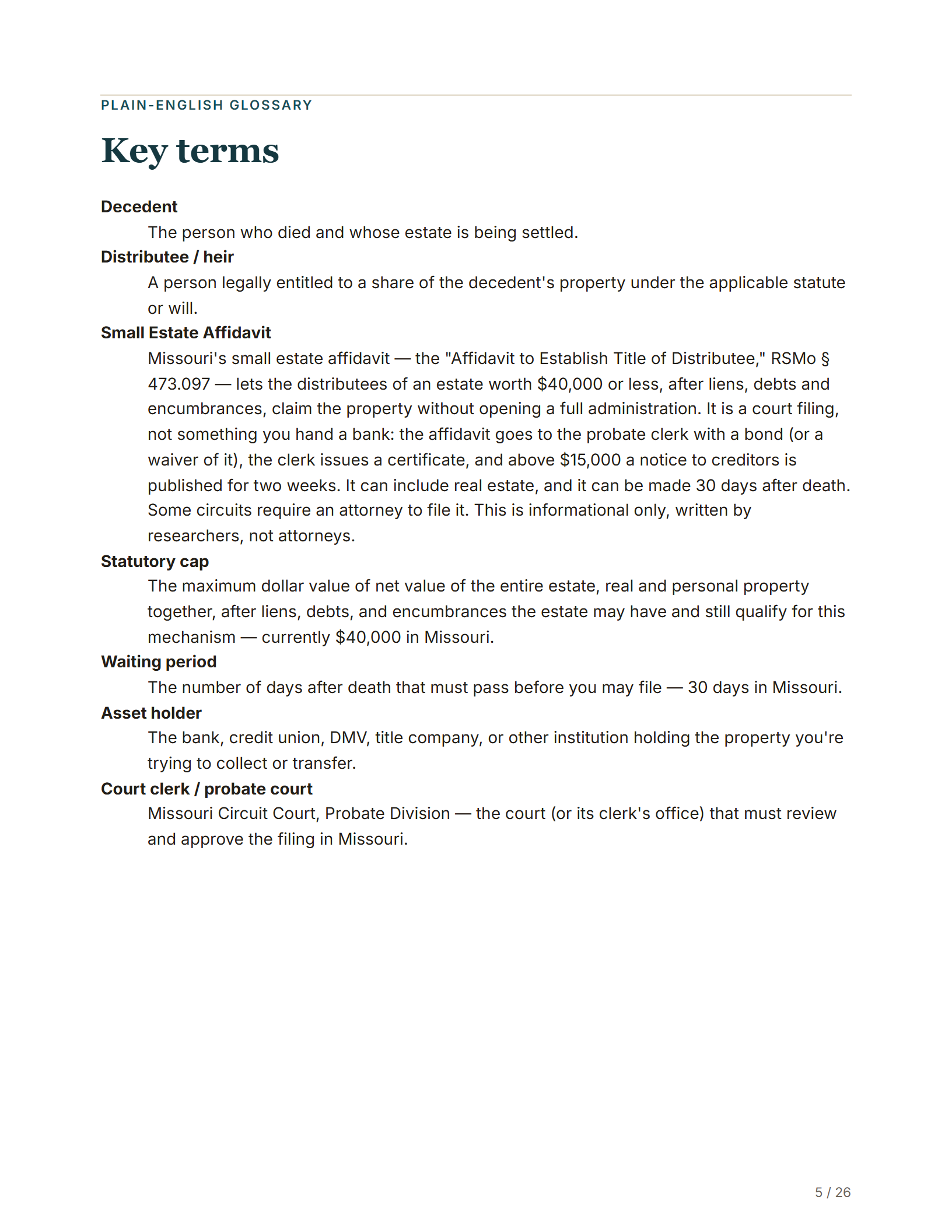
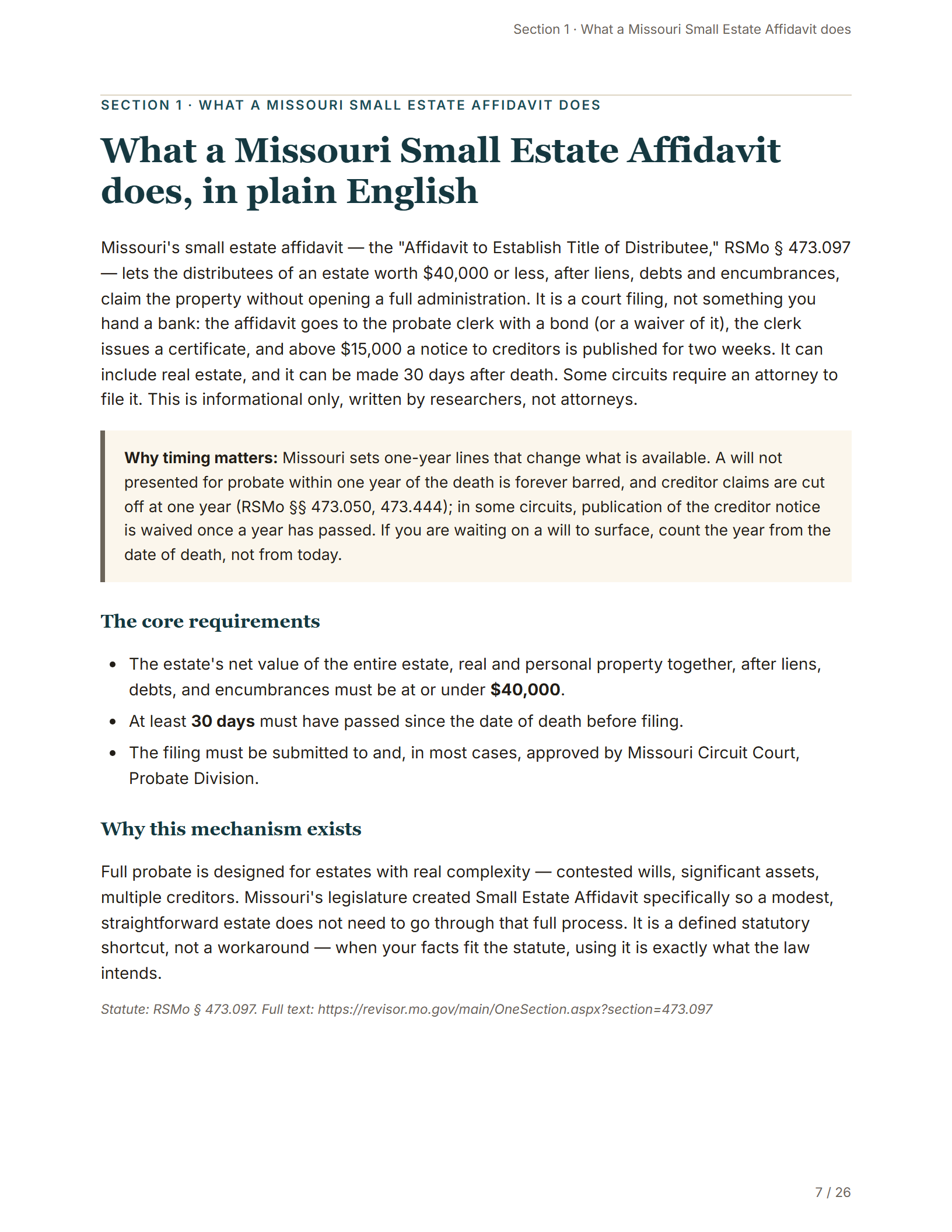
Missouri's small estate affidavit — the "Affidavit to Establish Title of Distributee," RSMo § 473.097 — lets the distributees of an estate worth $40,000 or less, after liens, debts and encumbrances, claim the property without opening a full administration. It is a court filing, not something you hand a bank: the affidavit goes to the probate clerk with a bond (or a waiver of it), the clerk issues a certificate, and above $15,000 a notice to creditors is published for two weeks. It can include real estate, and it can be made 30 days after death. Some circuits require an attorney to file it. This is informational only, written by researchers, not attorneys.
The state's own form is usually clear about the fields and silent about the process. Families commonly report
a bank branch insisting on court-issued Letters of Administration that the small estate statute doesn't
actually require, and each extra trip lands in the same weeks as the funeral. Closing that gap — between a
downloaded form and an asset holder who actually releases the property — is the whole reason this
guide exists. Written under the pen name James Whitfield; not an attorney.
Built on the statutory requirements, not a guess
Every claim cited to RSMo § 473.097
Secure checkout by Stripe
Money-back if the filing is rejected
Splitting up the estate with someone else? Send them this page before you start.
Why timing matters: Missouri sets one-year lines that change what is available. A will not presented for probate within one year of the death is forever barred, and creditor claims are cut off at one year (RSMo §§ 473.050, 473.444); in some circuits, publication of the creditor notice is waived once a year has passed. If you are waiting on a will to surface, count the year from the date of death, not from today. Miss the window and the estate is generally pushed into full probate instead — a probate attorney typically charges $1,500–$4,200+ for work this guide is built to help you avoid.
The Missouri $40,000 Small Estate Affidavit cap
Filing Small Estate Affidavit in Missouri starts with one number — the statutory cap. The estate, measured the way the statute measures it, has
to be at or under $40,000 (net value of the entire estate, real and personal property together, after liens, debts, and encumbrances), under RSMo § 473.097. This is a
statutory line, not a judgment call — the court or asset holder either sees the total under the cap or they
don't.
There's also a fixed 30-day waiting period after death before
you can file at all — separate from the eligibility question, and it doesn't move regardless of how quickly
you gather everything else.
Small Estate Affidavit is filed with the court, not handed directly to a bank or DMV. Each Missouri circuit's probate division issues its own version of the Affidavit to Establish Title of Distributee — typically with an assets exhibit, an heirs exhibit, a confidential filing sheet and a bond-waiver form — while RSMo § 473.097.2 fixes what the affidavit must say. See the how-to-file guide below for what the statute itself requires.
How to file, step by step
1
Check your circuit's rule on who may file
Call or check the probate division of the circuit court where the decedent lived. St. Louis County says an intestate small estate affidavit cannot be filed without an attorney; Jefferson County requires one for any estate over $15,000 or any estate with real property. If your circuit requires an attorney, the rest of these steps describe what the affidavit and the work around it must contain.
2
Total the estate at net value
List everything the decedent owned in their own name — real and personal property — at value on the date of death. Subtract liens, debts and encumbrances. Do not count property held as a tenant by the entirety or as a joint tenant. The net figure must be $40,000 or less.
3
Wait until 30 days after the death and confirm nothing else is pending
The affidavit can be made only thirty days or more after the death and only if no application for letters, administration or a refusal of letters is pending or has been granted for the decedent.
4
Decide who signs and whether a will exists
With no will, any distributee entitled to receive property of the decedent may sign. With a will presented for probate within one year of death, the personal representative the will names signs, and the will is presented with the affidavit.
5
Get your circuit's current packet
Download the affidavit, assets exhibit, heirs exhibit, bond-waiver form and checklist from your circuit's probate division page. Check the footer date.
6
List the heirs-at-law
Missouri's descent rules (RSMo § 474.010) decide who takes without a will — a surviving spouse, then children or their descendants, then parents, siblings and further relatives. Circuit packets ask for each heir's name, address and relationship and whether a deceased heir left descendants.
View source →
7
Itemize the property and who holds it
Describe each asset (bank, last four digits of the account number, current balance; vehicle, VIN and value; real estate, full legal description, street address and value) and name each person or institution that has possession.
8
Arrange the bond or its waiver
File a bond approved by the judge or clerk, or the waiver the court allows — consents from every adult competent heir, proof the funeral bill is paid, or a sole-heir request, depending on the circuit.
9
Sign before a notary and file with the probate clerk
The affiant swears to the affidavit before a notary. File it with the probate division clerk with a certified death certificate, the exhibits, the bond or waiver, and the filing fee set by that county. No court hearing is held.
10
Complete the creditor notice if the property exceeds $15,000
When the property listed is worth more than $15,000 the clerk causes a notice to creditors to be published once a week for two consecutive weeks in a qualified local newspaper; proof of publication is filed within ten days after publication ends. Some circuits waive publication when more than a year has passed since death.
11
Take the certified copy to each holder, and record it for real estate
After the clerk issues the certificate, order certified copies. Present one to each bank or other holder, and record a copy of the affidavit and certificate with the recorder of deeds in each county where land is located.
12
Collect, pay debts, and distribute
The affiant collects the property, liquidates as much as needed to pay the decedent's debts, and distributes the rest to the persons named in the affidavit. If the property cannot cover the debts, the heirs' shares abate in the order RSMo § 473.620 sets.
Missouri has two distinct court filings for settling an estate without full administration — and which
one applies depends on the size of the estate and how long ago the death was, not on a shared threshold.
An estate worth $40,000 or less after liens, debts and encumbrances: the
Small Estate Affidavit (RSMo § 473.097) is the filing — a sworn affidavit with a
bond (or a waiver), a clerk’s certificate, and a published notice to creditors above $15,000. It can include
real estate and can be made 30 days after death. Some circuits require an attorney to file it.
A death more than a year ago, with no estate opened and no will presented, when the need is to
establish who the heirs are: the
Determination of Heirship (RSMo § 473.663) is the filing — a
court petition with a hearing, mailed notice and four weeks of newspaper publication, and a decree recorded
in each county where land lies. It has no dollar cap and does not collect property or pay debts.
An estate over $40,000 within its first year is neither of these: Missouri’s full administration applies.
Searchers often ask for a Missouri “affidavit of heirship,” but no statute that transfers or establishes title
by a standalone affidavit was found in this research — the court procedure above is what the statute provides.
This page, and the two guides linked above, are informational only. They are not legal advice, and they do
not draft, file, or individualize any affidavit or petition on your behalf. For advice on your specific estate,
consult a licensed Missouri attorney.
What it actually looks like
Sample pages from the guide
Real pages from the Missouri guide PDF. Click any page to enlarge.
Print-friendly, readable on a phone or tablet, and designed to be taken to the bank or clerk. Every operational
claim cites the actual statute or official publication.
Yes — the standard form Missouri families use is free (that's the Free standard form column
below), though it isn't issued by the state itself. The $37 is for everything the free form leaves you to
work out alone: the eligibility check, the filing sequence, and what to do when a bank, DMV, or clerk pushes back.
This guide
Probate attorney
Free standard form
Doing nothing
Cost
$37
$1,500–4,200+
$0
Eventually full probate, if the estate is never settled
Time to filed
Same week to prepare; court approval timing varies by county
2–6 weeks
If you can decode it alone
Not until you act
Bank/DMV/clerk pushback script
Yes
Sometimes
No
n/a
Statute citations
Yes
n/a
n/a
n/a
Delivery time
Instant download
After consult + retainer
Instant
n/a
Attorney costs reflect typical Missouri probate-attorney retainers for this kind of filing.
The most-searched sticking point
What to do when a bank, DMV, or clerk pushes back
A facially valid filing still gets rejected on the first try more often than it should — usually because front-line staff have never processed one before, not because anything is actually wrong. This is the single biggest gap in every free state resource: none of them tell you what to actually say. The guide's Section 5 gives you the exact script and citation for each of these:
Bank or other holder will not release funds on the clerk's certificate and asks for letters instead
Probate clerk will not accept the filing from you without an attorney
Clerk requires a bond, or rejects the request to waive it
Clerk says the estate is over $40,000 or the values are unsupported
License office or recorder of deeds turns away the affidavit
Each one has a specific script and statutory citation behind it — not just "you're right, they're wrong," but
exactly what to say and what document to hand over. That's in the guide.
If a bank, DMV, title company, or court clerk rejects your filing for a reason traceable to following this
guide, you get a full refund.
Email the stated rejection reason to support@estateaffidavitguide.com within 30 days of
purchase and we refund the full purchase price within one business day. No phone tag, no forms, no fight.
Not covered: an estate that turns out to be over the dollar limit, a dispute among heirs, or a missing document
unrelated to the filing itself. Changed your mind for any other reason? You have 7 days, no questions asked.
Full refund policy.
Avoid these
6 common reasons filings get rejected
▸ The estate is worth more than $40,000 after liens, debts and encumbrances
The affidavit must state that the value of the entire estate, real and personal property together, less liens, debt and encumbrances, does not exceed $40,000. A tenancy by the entirety or joint tenancy asset is not counted as the decedent's property. Circuit packets require supporting proof for any debt used to reach the figure. — RSMo § 473.097.1(1), .2(3)
▸ Fewer than 30 days have passed, or letters or a refusal of letters is pending or was granted
The affidavit may be made only after thirty days from the death, and only if no application for letters, for administration, or for refusal of letters under § 473.090 is pending or has been granted (unless a refusal was later revoked). — RSMo § 473.097.1(2), .2
▸ The will was not presented for probate in time, or the signer is not the right person
If there is a will, the affiant is the personal representative it names, and only if the will was presented within the § 473.050 limit — one year from death where no notice of letters was given. Without a will, any distributee entitled to receive property may sign. — RSMo § 473.097.2; § 473.050.3
▸ No bond, or no valid waiver
A bond in at least the value of the personal property must be filed unless the court finds it unnecessary. What counts as enough to waive it differs by circuit. — RSMo § 473.097.1(3)
▸ The affidavit leaves out a required item
It must say whether there was a will, that debts and estate taxes have been or will be paid (with the affiant's liability limited to what the affiant receives), give an itemized description and valuation of the property, name each person holding it, name and give the address and relationship of everyone who will receive each item, and state the facts establishing their right. The St. Louis County packet requires a complete list of heirs-at-law with their lineage. — RSMo § 473.097.2(1)-(6)
▸ Fee paid but notice to creditors not completed
A filing fee under § 483.580 and, when the property listed is worth more than $15,000, the publication cost of the notice to creditors must be paid or proved to the clerk, with proof of publication filed within ten days after the notice runs. — RSMo § 473.097.1(4), .5
Before you present the Missouri Small Estate Affidavit
Most rejected-on-the-first-try filings are a front-line-staff problem, not an eligibility problem. This free one-pager has what to bring and what to say the first time you hand it to a bank, DMV, or clerk — emailed now. We'll also send a few short follow-ups over the next few weeks (why most pushback is unfamiliarity not law, the exact citation to point to, when to call an attorney) — then we stop. No ongoing newsletter.
Questions
Frequently asked questions
What is the Missouri small estate affidavit called?
RSMo § 473.097 is headed "Small estate — distribution of assets without letters," and the court form is the "Affidavit to Establish Title of Distributee to Property in Estate of $40,000 or less." People search it as "small estate affidavit," "affidavit for collection of small estate," and by the clerk's "small estate certificate."
What is the limit?
$40,000 — the value of the entire estate, real and personal property together, less liens, debts and encumbrances (RSMo § 473.097.1(1)). Property held as a tenant by the entirety or joint tenant is not counted as the decedent's property.
Is a Missouri small estate affidavit filed with a court?
Yes. Unlike a number of states, the affidavit is filed with the clerk of the probate division, which issues a certificate; you then use certified copies with banks and record one for real estate (RSMo § 473.097.2-.4). No hearing is held.
Can I file it myself without a lawyer?
It depends on your circuit. The St. Louis County Probate Division's packet says an intestate small estate affidavit cannot be filed pro se. A 2022 administrative order in Jefferson County requires an attorney for any estate over $15,000 or with real property and allows a layperson only for an estate under $15,000 with no real property. Other circuits were not verified — ask your probate clerk.
How long do I wait after the death?
Thirty days from the date of death before the affidavit can be made, and nothing may be pending for letters or a refusal of letters (RSMo § 473.097.1(2)).
Is there an outer deadline?
For an intestate decedent, no statutory deadline appears in § 473.097 — Jackson County's manual confirms an intestate affidavit may be filed after one year. If there is a will, it must be presented for probate within one year of death or it is forever barred (§ 473.050), so the affidavit can then proceed only as an intestate estate.
Does the affidavit work if there is a will?
Yes, if the will was presented for probate within the § 473.050 time limit. The personal representative the will names signs, and the heirs are the devisees under the will (§ 473.097.2). If the will was not presented in time, only the version for an estate without a will is available.
What does it cost?
Court costs follow RSMo § 483.580 and the circuit's fee schedule, so they vary by county — one 2025 Jefferson County packet lists $85.50 for an intestate small estate and $120.50 with a will, plus about $40 for publication when the property exceeds $15,000. A surety bond, if required, is an additional cost, and recording costs are separate. No attorney-cost figure was sourced for this guide.
Does the affidavit cover real estate?
Yes. The statute covers "personal property or real property or both" and lets the distributees establish their right to land by recording a copy of the affidavit and the clerk's certificate with the recorder of deeds in each county where it is located (RSMo § 473.097.4). The value of the land counts toward the $40,000 limit, net of mortgages and liens.
What if a bank refuses the certificate?
The statute gives the filing the effect of administration for establishing the distributees' right (§ 473.097.6) but does not require a holder to pay and has no penalty for refusing, and one circuit's clerk packet warns that banks may refuse it. Ask the bank to state the requirement it says is missing. After a year, letters of administration generally cannot be sought (§ 473.050.6), so the alternatives for an old estate are narrow.
How is this different from a refusal of letters?
A refusal of letters (RSMo § 473.090) is a separate short-form court order: for a surviving spouse or minor children when the estate does not exceed their exempt property and allowances, or for a creditor (including someone who paid the funeral bill) when the personal estate is $15,000 or less and there is no spouse or minor children. It is discretionary, and real property passes only on the spouse-and-children version. An application for it blocks the small estate affidavit while pending or granted.
Am I responsible for the decedent's debts?
To the extent of what you receive. The affidavit states that all unpaid debts and any estate taxes have been or will be paid, with the affiant's liability for unpaid claims limited to the value of the property received (§ 473.097.2(2)). The bond is conditioned on paying debts, funeral and burial expenses, and obeying future court orders.
Which Missouri filing applies to my situation?
As a rule of thumb: an estate worth $40,000 or less after liens, debts and encumbrances, with at least 30 days since the death and no letters applied for, points to the Small Estate Affidavit (RSMo § 473.097) — a court filing with a bond or waiver and a clerk's certificate. A death more than a year ago, with no estate ever opened and no will presented in time, where the need is to establish who the heirs are — often to clear title to land — points to the Determination of Heirship (RSMo § 473.663), which has no dollar cap. They don't fork on a single fact, and either can apply to an intestate decedent who died more than a year ago. An estate over $40,000 within the first year is neither: full administration applies. This is informational only, not legal advice or a determination of which filing applies to your estate.
Does Missouri require a lawyer for these filings?
The statutes do not, but local court rules can. St. Louis County's Probate Division says the intestate small estate affidavit cannot be filed pro se, and the 23rd Circuit (Jefferson County) requires an attorney for any estate over $15,000 or with real property. Other circuits were not verified — ask your probate clerk, who cannot give legal advice but can tell you the filing rule.
Ready to start?
$37, one time. Instant download.
Money-back if your filing is rejected for a reason traceable to following the guide, or for any other
reason within 7 days.
No waiting room, no retainer. The 30-day wait after death is fixed, but most of the
remaining delay families hit is an avoidable rejection or a second trip back to the same bank, DMV, or clerk —
this guide is built to help you avoid both on the first visit.
One last step — confirm below and it's instant from there.
Secure checkout by Stripe · Instant download · Money-back guarantee
Want a sibling or co-executor caught up? Send them what you just read.
5 short, plain-English emails over the following weeks — the eligibility math, the small estate affidavit presentation moment, why most rejections are paperwork not eligibility, and when to call an attorney instead. Then we stop. No ongoing newsletter, no sales list. Unsubscribe anytime.
Primary sources
State sources
▸
Every claim here cites the actual statute or an official publication — see them
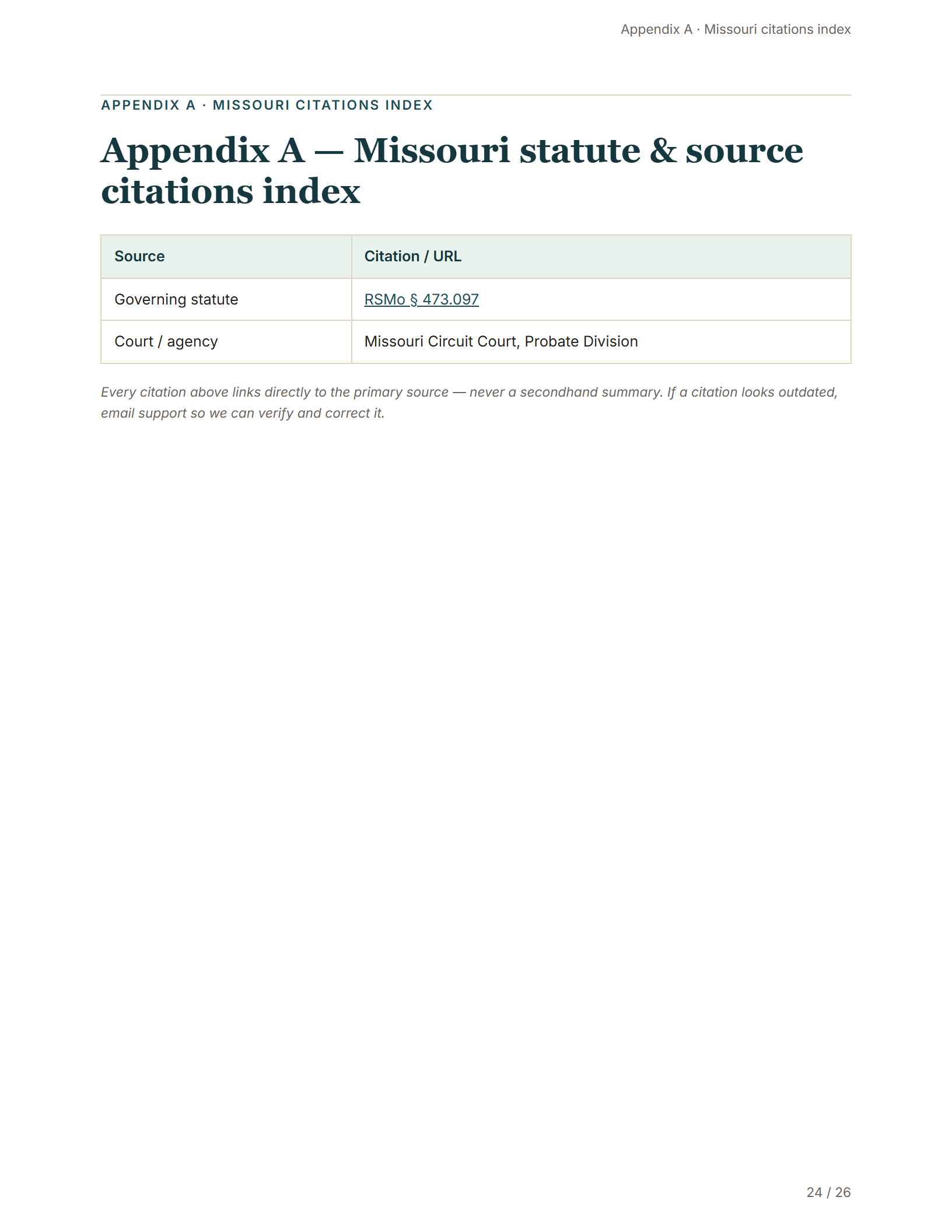
Statute: RSMo § 473.097
. The primary source behind every requirement, cap, and deadline described above.
Missouri Guide — $37
Instant download · Refund if rejected due to the guide
What to bring and what to say the first time you hand a Missouri Small Estate Affidavit to a bank, DMV, or clerk — emailed now, plus a few short follow-ups over the next few weeks, then we stop. No ongoing newsletter.
Free checklist
Before you present the Missouri Small Estate Affidavit
What to bring and what to say the first time you hand it to a bank, DMV, or clerk — so unfamiliarity on their end doesn't turn one trip into two. Emailed now, plus a few short follow-ups over the next few weeks, then we stop. No ongoing newsletter.