If a bank told you an account is frozen and didn't explain what that actually means, you're not stuck, and
you're not the only one this has happened to. A probate attorney would typically charge $1,500–$4,200+ to walk you through exactly what Minnesota law
already lets you do yourself. This kit is $37,
one-time, and covers the same ground — the eligibility rule, the official form, and what to say if a bank or
clerk pushes back.
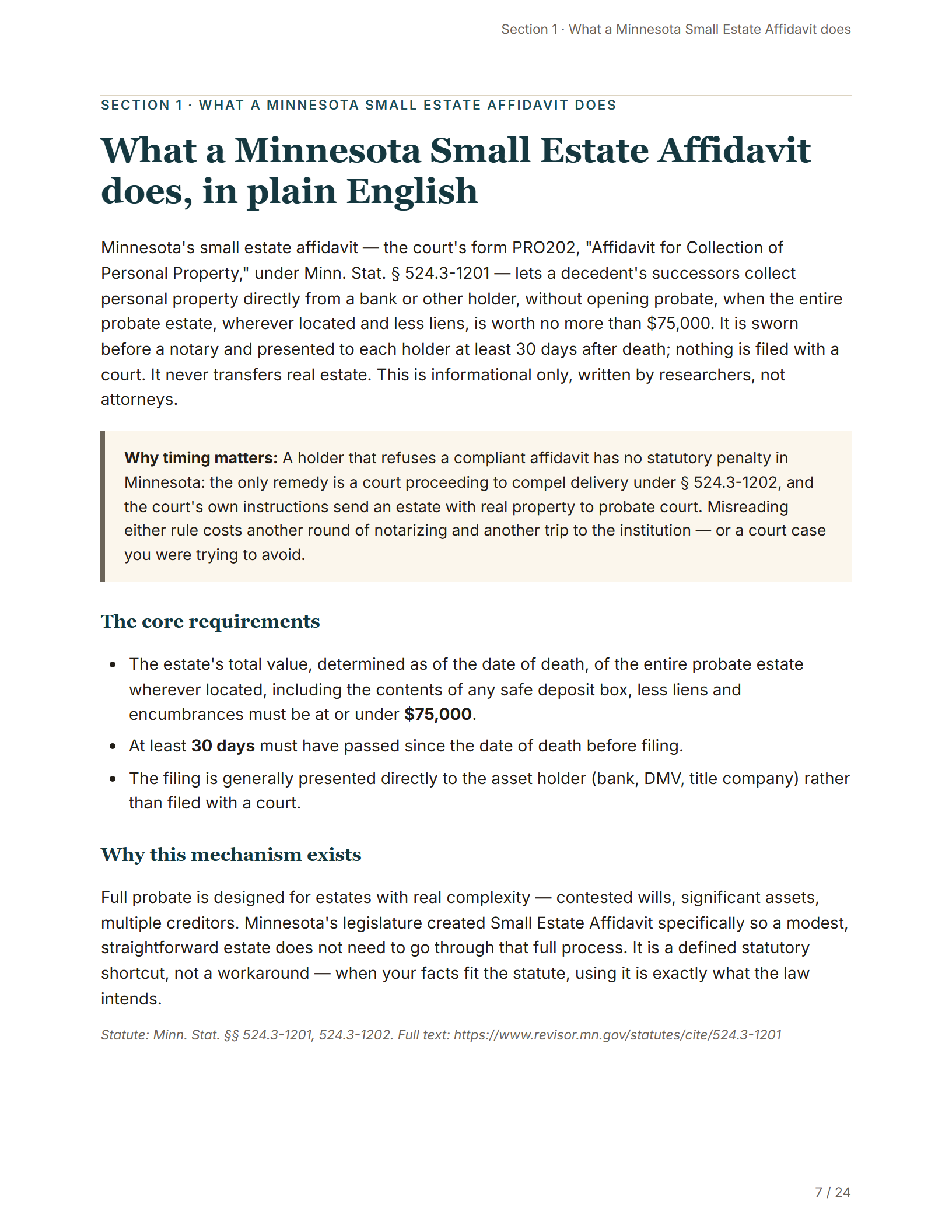
Minnesota's small estate affidavit — the court's form PRO202, "Affidavit for Collection of Personal Property," under Minn. Stat. § 524.3-1201 — lets a decedent's successors collect personal property directly from a bank or other holder, without opening probate, when the entire probate estate, wherever located and less liens, is worth no more than $75,000. It is sworn before a notary and presented to each holder at least 30 days after death; nothing is filed with a court. It never transfers real estate. This is informational only, written by researchers, not attorneys.
The state's own form is usually clear about the fields and silent about the process. Families commonly report
a bank branch insisting on court-issued Letters of Administration that the small estate statute doesn't
actually require, and each extra trip lands in the same weeks as the funeral. Closing that gap — between a
downloaded form and an asset holder who actually releases the property — is the whole reason this
kit exists. Written under the pen name James Whitfield; not an attorney.
Built on the official state form
Every claim cited to Minn. Stat. §§ 524.3-1201, 524.3-1202
Secure checkout by Stripe
Money-back if the affidavit is rejected
Splitting up the estate with someone else? Send them this page before you start.
Why timing matters: A holder that refuses a compliant affidavit has no statutory penalty in Minnesota: the only remedy is a court proceeding to compel delivery under § 524.3-1202, and the court's own instructions send an estate with real property to probate court. Misreading either rule costs another round of notarizing and another trip to the institution — or a court case you were trying to avoid. Miss the window and the estate is generally pushed into full probate instead — a probate attorney typically charges $1,500–$4,200+ for work this kit is built to help you avoid.
Total what the decedent owned that is subject to probate and compare it with $75,000
Add up the value, as of the date of death, of everything the decedent owned in their name alone, wherever located, including any safe deposit box contents, then subtract liens and encumbrances. Compare the result with $75,000. Property that passes outside the estate (a joint account, an account with a beneficiary) is not in that group. The court's instructions also say to use the form only if there is no real property in the probate estate.
2
Wait at least 30 days from the date of death
A holder's duty to pay or deliver begins thirty days after death. For a safe deposit box, count thirty days from the filing of the box inventory instead.
3
Confirm no personal representative has been appointed or applied for
The affidavit states that no application or petition for appointment of a personal representative is pending or has been granted in any jurisdiction.
4
Get certified death certificates
The affidavit must be presented with a certified death record, and the court's form says a certified copy of the death certificate is attached. Each holder usually keeps its copy, so order several.
5
Complete the court's PRO202
The one-page form asks for your name and address; the date of death; why you are the successor with legal standing; a statement that the probate estate does not exceed $75,000; that thirty days have passed; that no personal representative has been appointed or applied for; and a description of the property you are entitled to collect. Use the current revision (Rev 3/23).
View source →
6
Sign before a notary
The form is sworn or affirmed before a notary public. Nothing is filed with a court and there is no court filing fee.
7
Present the affidavit and death certificate to each holder
Take them to each bank, brokerage, stock company or other person holding the property or owing the debt. The statute says the holder shall pay or deliver, and a holder that does is discharged as if it had dealt with a personal representative. A transfer agent changes registered ownership on the same affidavit.
8
Use the motor vehicle division for a vehicle
Take the affidavit with the death certificate to the motor vehicle division; the statute directs the registrar to issue a new title to the successor. Confirm its current requirements before you go.
9
Disburse to anyone with a superior claim
A successor who collects must pay out to any person with a superior claim and is answerable to a personal representative or anyone else with a superior right (Minn. Stat. §§ 524.3-1201(c), 524.3-1202).
Minnesota has two distinct legal mechanisms for settling a modest or long-unsettled estate
without full probate — and which one applies depends on the asset and the time since death, not a shared dollar threshold.
Personal property — bank accounts, vehicles, securities, and similar assets — in a probate
estate worth $75,000 or less: the Small Estate Affidavit (Minn. Stat.
§ 524.3-1201, form PRO202) is the mechanism — a sworn affidavit presented directly to whoever
holds the property, no court filing, at least 30 days after death. It never transfers real estate.
Real or personal property, any value, when the person has been dead more than three years and
nothing was probated: the Decree of Descent (Minn. Stat.
§§ 525.31-525.313, form PRO1402) is the mechanism — a court petition with mailed and published
notice, a hearing, and a Medical Assistance clearance.
A house within three years of death, in an estate that isn’t tiny, is neither of these: Minnesota’s
ordinary probate process applies. Picking the wrong mechanism wastes real time — presenting a bank with
a court petition, or trying to use the affidavit to move land, won’t work.
This page, and the two mechanism guides linked above, are informational only. They are not legal advice,
and they do not draft, file, or individualize any affidavit or petition on your behalf. For advice on
your specific estate, consult a licensed Minnesota attorney.
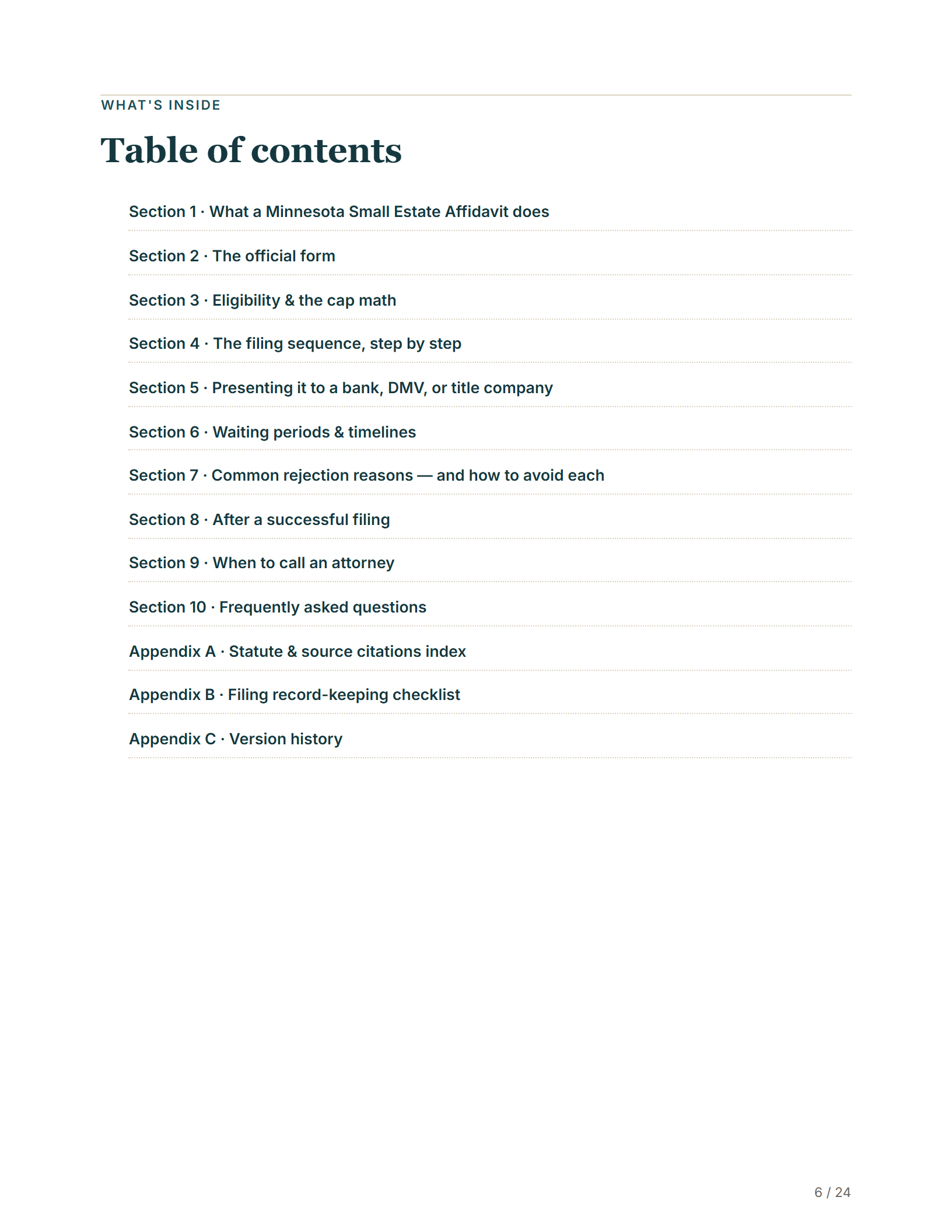
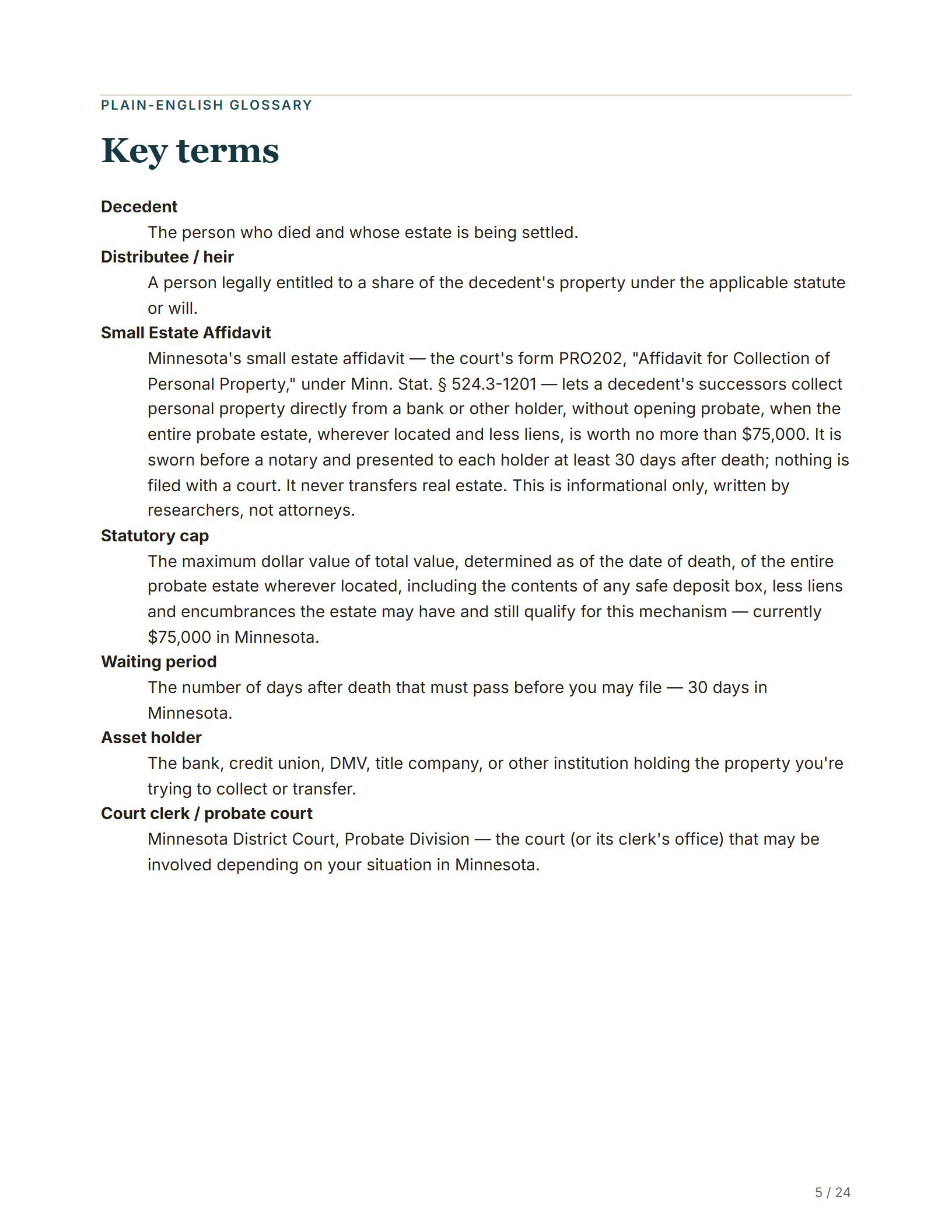
What it actually looks like
Sample pages from the kit
Real pages from the Minnesota kit PDF. Click any page to enlarge.
Print-friendly, readable on a phone or tablet, and designed to be taken to the bank or clerk. Every operational
claim cites the actual statute or official publication.
Yes — Minnesota's own form is free (that's the Free state form column below). The $37
is for everything the free form leaves you to work out alone: the eligibility check, the filing sequence, and
what to do when a bank, DMV, or clerk pushes back.
This kit
Probate attorney
Free state form
Doing nothing
Cost
$37
$1,500–4,200+
$0
Eventually full probate, if the estate is never settled
Time to filed
Same week
2–6 weeks
If you can decode it alone
Not until you act
Bank/DMV/clerk pushback script
Yes
Sometimes
No
n/a
Statute citations
Yes
n/a
n/a
n/a
Delivery time
Instant download
After consult + retainer
Instant
n/a
Attorney costs reflect typical Minnesota probate-attorney retainers for this kind of filing.
The most-searched sticking point
What to do when a bank, DMV, or clerk pushes back
A facially valid filing still gets rejected on the first try more often than it should — usually because front-line staff have never processed one before, not because anything is actually wrong. This is the single biggest gap in every free state resource: none of them tell you what to actually say. The kit's Section 5 gives you the exact script and citation for each of these:
Bank or other holder refuses a compliant affidavit and asks for court-issued Letters instead
Institution says the estate is disqualified or over the limit because a house is involved
Safe deposit company declines to open the box
Vehicle title transfer is turned away at the motor vehicle division
Each one has a specific script and statutory citation behind it — not just "you're right, they're wrong," but
exactly what to say and what document to hand over. That's in the kit.
If a bank, DMV, title company, or court clerk rejects your filing for a reason traceable to following this
kit, you get a full refund.
Email the stated rejection reason to support@estateaffidavitguide.com within 30 days of
purchase and we refund the full purchase price within one business day. No phone tag, no forms, no fight.
Not covered: an estate that turns out to be over the dollar limit, a dispute among heirs, or a missing document
unrelated to the filing itself. Changed your mind for any other reason? You have 7 days, no questions asked.
Full refund policy.
Avoid these
5 common reasons filings get rejected
▸ The probate estate is worth more than $75,000
The affidavit must state that the value of the entire probate estate, determined as of the date of death, wherever located, including any safe deposit box contents, less liens and encumbrances, does not exceed $75,000. Property that passes outside the estate, such as a joint account or one with a beneficiary, is outside that group. — Minn. Stat. § 524.3-1201(a)(1); PRO202 ¶ 5
▸ Fewer than 30 days have passed
A holder's duty starts thirty days after death. For a safe deposit box, the thirty days run from the filing of the box inventory instead. — Minn. Stat. § 524.3-1201(a), (a)(2); PRO202 ¶ 6
▸ A personal representative has been appointed or applied for
The affidavit states that no application or petition for appointment of a personal representative is pending or has been granted in any jurisdiction. Once someone has been appointed or applied, the affidavit is no longer available. — Minn. Stat. § 524.3-1201(a)(3); PRO202 ¶ 7
▸ Real property is part of the probate estate
The affidavit collects personal property and can never transfer land. The court's instructions say to use the form only if there is no real property in the probate estate and that real property requires probate court to transfer. The statute's own value test counts the entire probate estate wherever located. — Minn. Stat. § 524.3-1201(a)(1); PRO201
▸ The person signing is not the successor entitled to the property
The affidavit must state that the claiming successor is entitled to payment or delivery of the property, and the court's form asks why the signer has legal standing. Anyone who collects is answerable to a personal representative or any person with a superior right. — Minn. Stat. §§ 524.3-1201(a)(5), (c), 524.3-1202; PRO202 ¶¶ 4, 8
Before you present the Minnesota Small Estate Affidavit
Most rejected-on-the-first-try filings are a front-line-staff problem, not an eligibility problem. This free one-pager has what to bring and what to say the first time you hand it to a bank, DMV, or clerk — emailed now. We'll also send a few short follow-ups over the next few weeks (why most pushback is unfamiliarity not law, the exact citation to point to, when to call an attorney) — then we stop. No ongoing newsletter.
Questions
Frequently asked questions
What is Minnesota's small estate affidavit called officially?
The statute, Minn. Stat. § 524.3-1201, is titled "Collection of personal property by affidavit," and the court's form is PRO202, "Affidavit for Collection of Personal Property," with one-page instructions (PRO201) titled "Small Estate - No Real Estate." "Small estate affidavit" is the common name for the same process; searchers also use "affidavit of collection."
What is Minnesota's small estate affidavit limit?
$75,000 — the value of the entire probate estate, determined as of the date of death, wherever located, including any safe deposit box contents, less liens and encumbrances (Minn. Stat. § 524.3-1201(a)(1)). The figure is printed on the court's current PRO202 (Rev 3/23).
How long do I have to wait?
Thirty days after the date of death. For a safe deposit box, thirty days after the filing of the box inventory (Minn. Stat. § 524.3-1201(a)(2)).
Do I file this affidavit with a court?
No. It is sworn before a notary and given to each holder with a certified death certificate. A court is involved only if a holder refuses and you bring a proceeding to compel delivery under Minn. Stat. § 524.3-1202.
Can I use it to transfer a house?
No. The affidavit collects personal property; it can never transfer land. The court's instructions (PRO201) also say to use the form only if there is no real property in the probate estate, and that real property requires probate court. If the decedent died more than three years ago and nothing was ever probated, Minnesota has a separate court process for real or personal property, the decree of descent, covered on this site's Minnesota Decree of Descent guide.
Does a house count toward the $75,000 limit?
The statute tests the value of the entire probate estate wherever located (Minn. Stat. § 524.3-1201(a)(1)), and the statute's definition of "estate" includes all of the decedent's property (§ 524.1-201(18)). The court's instructions separately say to use the form only if there is no real property in the probate estate. Property that passes outside the estate, such as a house held in joint tenancy, is not part of the probate estate. No Minnesota decision or agency guidance was found that squares the two, so compare the statute's wording and the court's instructions with your own facts.
What if a bank refuses to honor the affidavit?
Minn. Stat. § 524.3-1201(a) says a holder "shall" pay or deliver on a compliant affidavit and a certified death record, and § 524.3-1202 discharges one that does. If a holder refuses, § 524.3-1202 allows a court proceeding to compel payment or delivery upon proof of the right. Unlike some other states, Minnesota's statute has no fee-shifting or damages provision for a wrongful refusal. No named Minnesota refusal account was found in this research.
Can I use the affidavit for a car?
The statute directs the motor vehicle registrar to issue a new certificate of title to the successor on a compliant affidavit (Minn. Stat. § 524.3-1201(d)), and the court's instructions say to take the affidavit and death certificate to the motor vehicle division. Confirm the division's current requirements before you go.
Does it matter whether there was a will?
Not to the form's own conditions. The court's instructions say the person may or may not have had a will. You must be the successor entitled to the property: named to receive it in a will, or entitled to it under the intestacy rules (for example a spouse; a child if there is no spouse; a parent if there is no spouse or child; a sibling if there is no spouse, child, grandchild or parent).
What about a safe deposit box?
The contents count toward the $75,000. The thirty days run from the filing of the box inventory. The custodian need not open the box if it has notice of an objection from anyone, or reason to believe there would be one, or if the key or combination is not available (Minn. Stat. § 524.3-1201(a)(2), (e)).
Does this affect a Medical Assistance claim?
The same statute lets a state or county agency with a Medical Assistance claim under Minn. Stat. § 256B.15 use this affidavit to collect, and any successor who collects must disburse the proceeds to anyone with a superior claim and answer to a later-appointed personal representative (§§ 524.3-1201(c), 524.3-1202). Whether a claim exists against a particular estate is outside what this guide can determine.
Is there a smaller procedure inside probate?
Yes, but it is a court proceeding. Under Minn. Stat. § 524.3-1203, a court may summarily close an estate and assign its property without further notice when the gross probate estate, excluding exempt homestead and exempt property, does not exceed $150,000. It is a court proceeding that starts with a petition, and it is a different path from the affidavit.
Which Minnesota mechanism applies to my situation?
As a rule of thumb: personal property (bank accounts, vehicles, securities) in a probate estate worth $75,000 or less, with at least 30 days since death and no personal representative applied for, points to the Small Estate Affidavit (Minn. Stat. § 524.3-1201) — presented directly to the bank or other holder, no court filing. A decedent who has been dead more than three years, with real or personal property and no probate ever held, points instead to the Decree of Descent (Minn. Stat. § 525.31) — a court petition with notice, publication, a hearing and a Medical Assistance clearance, with no dollar cap. The two do not fork on a single fact: one is a dollar-and-asset line, the other a time-and-court line, and an estate can be eligible for both (a long-dead person with a bank account) or neither (a house within three years of death is ordinary probate). This is informational only, not legal advice or a determination of which mechanism applies to your estate.
Does Minnesota call this a 'small estate affidavit' like most other states?
Yes, for the personal-property mechanism — the statute is Minn. Stat. § 524.3-1201, "Collection of personal property by affidavit," and searchers also use "affidavit for collection of personal property" and "affidavit of collection." The court-supervised route for an estate dead more than three years is a "decree of descent" in the statute and a "determination of descent" on the court's forms.
Ready to start?
$37, one time. Instant download.
Money-back if your filing is rejected for a reason traceable to following the kit, or for any other
reason within 7 days.
No waiting room, no retainer. The 30-day wait after death is fixed, but most of the
remaining delay families hit is an avoidable rejection or a second trip back to the same bank, DMV, or clerk —
this kit is built to help you avoid both on the first visit.
One last step — confirm below and it's instant from there.
Secure checkout by Stripe · Instant download · Money-back guarantee
Want a sibling or co-executor caught up? Send them what you just read.
5 short, plain-English emails over the following weeks — the eligibility math, the small estate affidavit presentation moment, why most rejections are paperwork not eligibility, and when to call an attorney instead. Then we stop. No ongoing newsletter, no sales list. Unsubscribe anytime.
Primary sources
State sources
▸
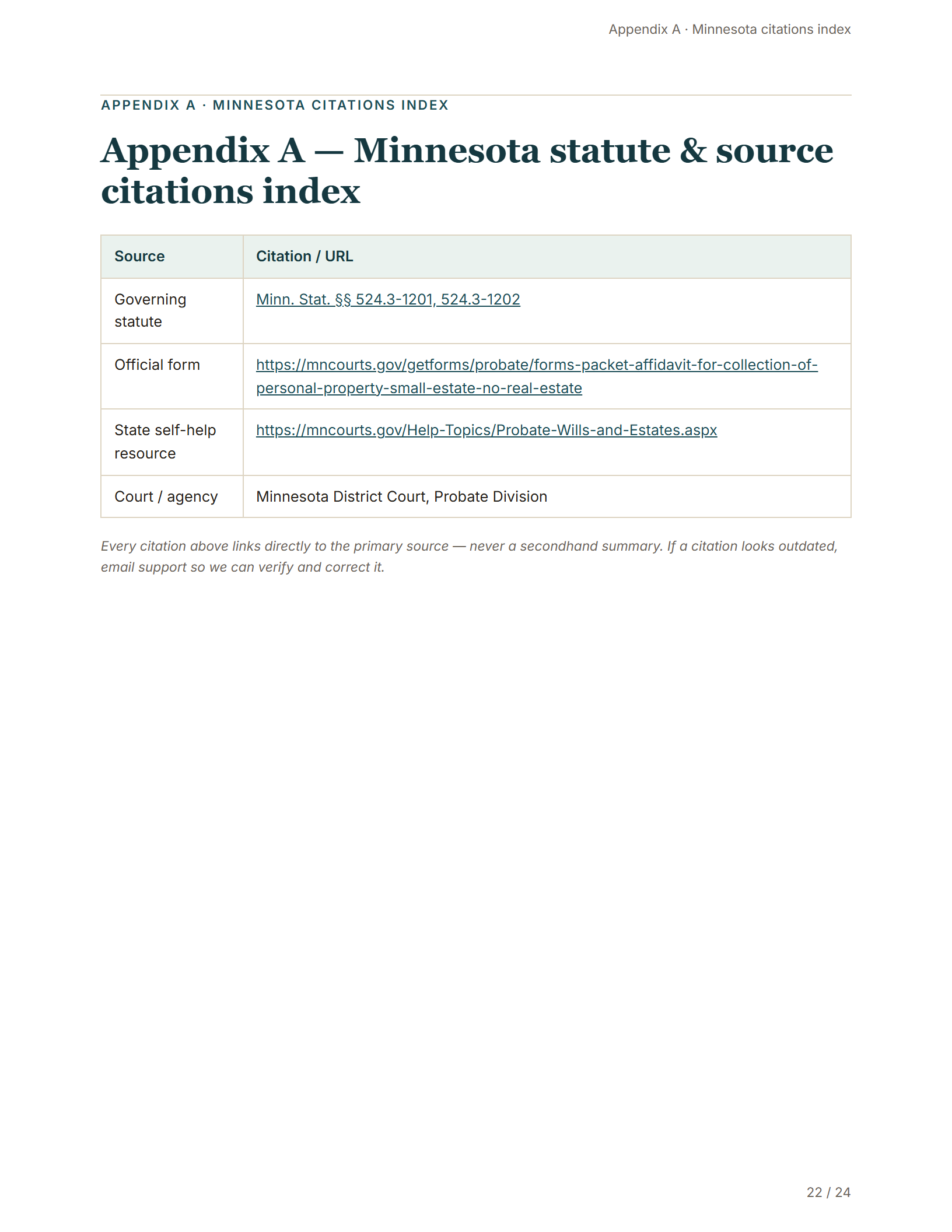
Every claim here cites the actual statute or an official publication — see them
Official form:
Official Small Estate Affidavit form
The Minnesota Judicial Branch's form PRO202, "Affidavit for Collection of Personal Property" (Rev 3/23, one page), is the form. The court's one-page instructions, PRO201 (Rev 8/16), are titled "Small Estate - No Real Estate." The affidavit is sworn before a notary and presented to the holder with a certified death certificate; nothing is filed with a court. The court's PDFs refuse automated downloads, so use the form page in an ordinary browser.
What to bring and what to say the first time you hand a Minnesota Small Estate Affidavit to a bank, DMV, or clerk — emailed now, plus a few short follow-ups over the next few weeks, then we stop. No ongoing newsletter.
Free checklist
Before you present the Minnesota Small Estate Affidavit
What to bring and what to say the first time you hand it to a bank, DMV, or clerk — so unfamiliarity on their end doesn't turn one trip into two. Emailed now, plus a few short follow-ups over the next few weeks, then we stop. No ongoing newsletter.