If a bank told you an account is frozen and didn't explain what that actually means, you're not stuck, and
you're not the only one this has happened to. A probate attorney would typically charge $1,500–$4,200+ to walk you through exactly what Alabama law
already lets you do yourself. This guide is $37,
one-time, and covers the same ground — the eligibility rule, the official form, and what to say if a bank or
clerk pushes back.
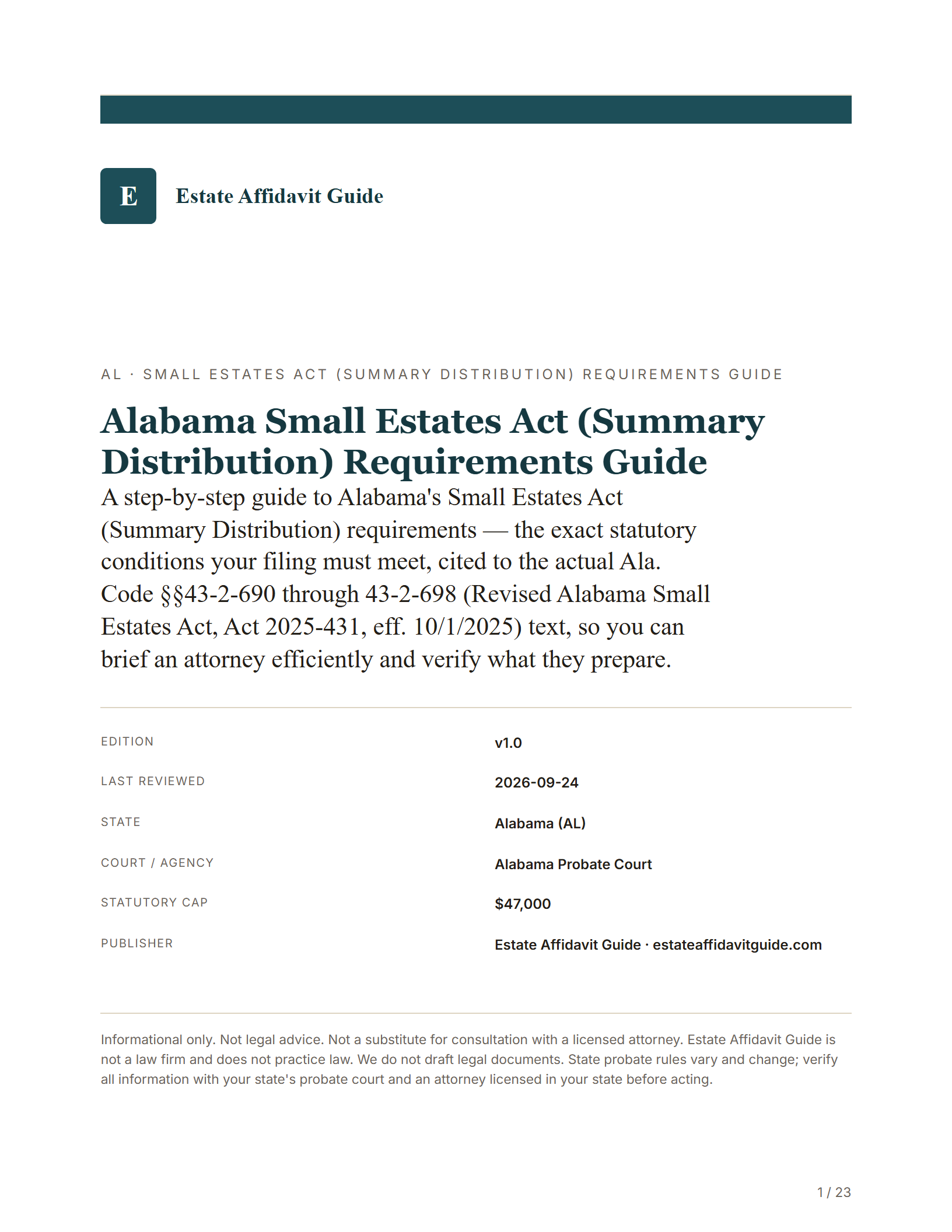
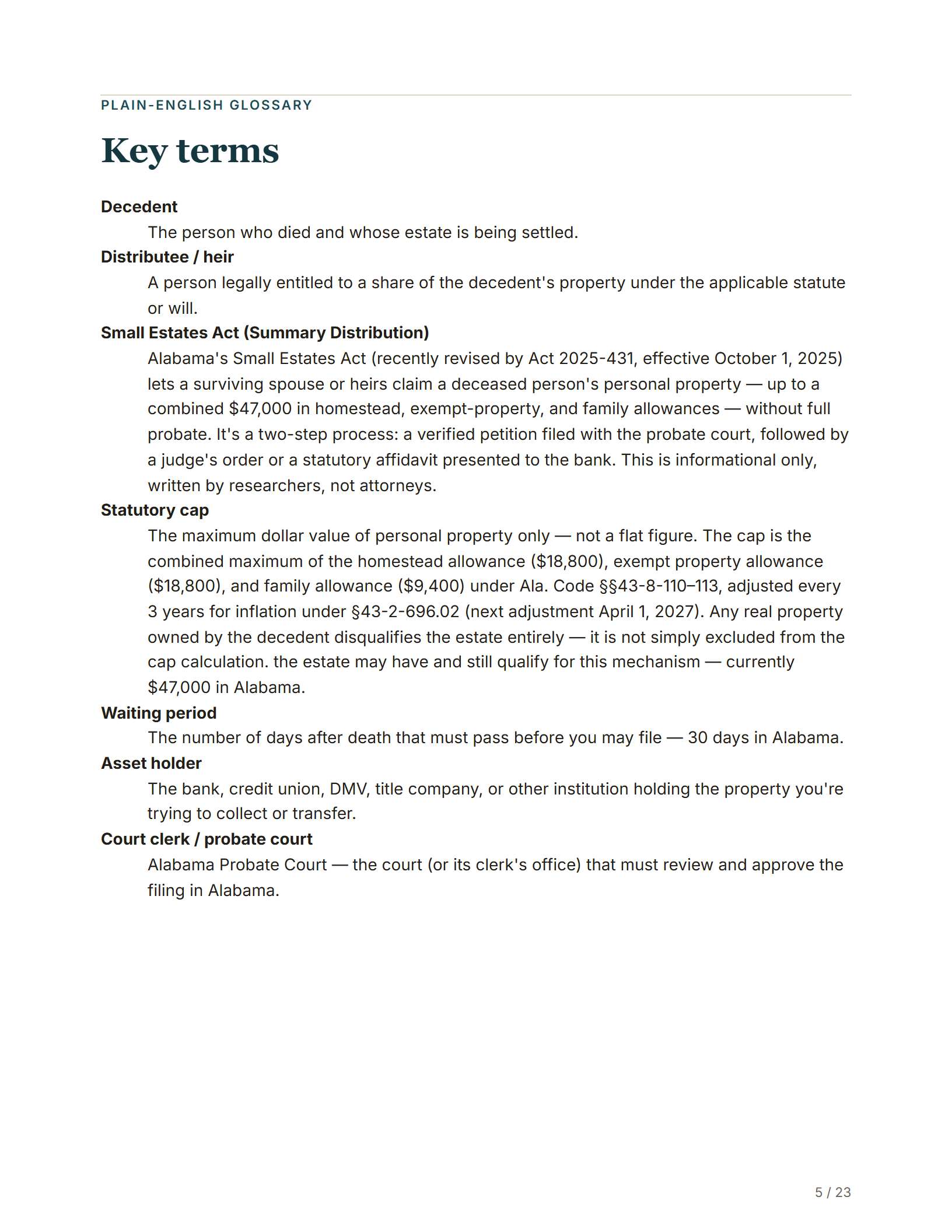
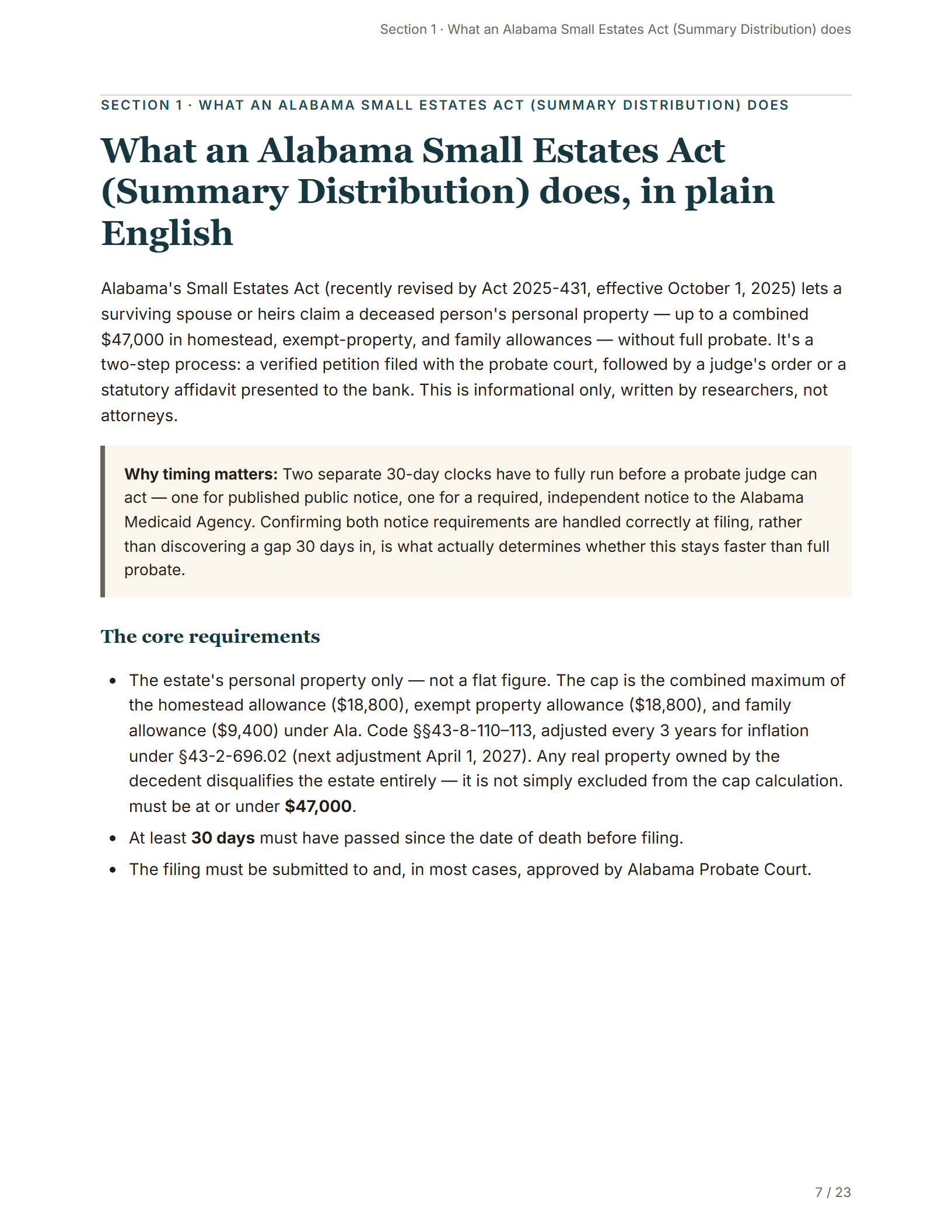
Alabama's Small Estates Act (recently revised by Act 2025-431, effective October 1, 2025) lets a surviving spouse or heirs claim a deceased person's personal property — up to a combined $47,000 in homestead, exempt-property, and family allowances — without full probate. It's a two-step process: a verified petition filed with the probate court, followed by a judge's order or a statutory affidavit presented to the bank. This is informational only, written by researchers, not attorneys.
Last reviewed
Why this guide exists
The state's own form is usually clear about the fields and silent about the process. Families commonly report
a bank branch insisting on court-issued Letters of Administration that the small estate statute doesn't
actually require, and each extra trip lands in the same weeks as the funeral. Closing that gap — between a
downloaded form and an asset holder who actually releases the property — is the whole reason this
guide exists. Written under the pen name James Whitfield; not an attorney.
Built on the statutory requirements, not a guess
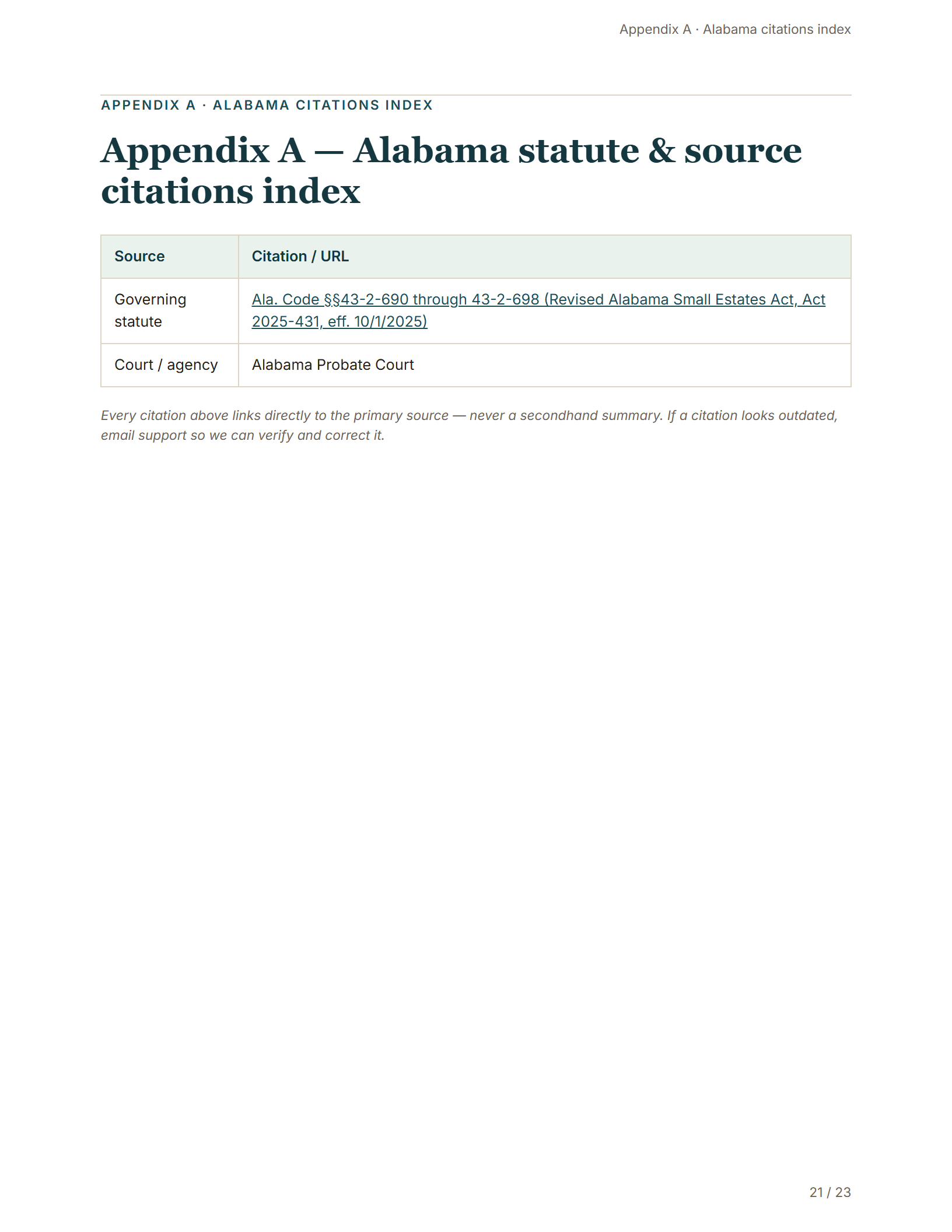
Every claim cited to Ala. Code §§43-2-690 through 43-2-698 (Revised Alabama Small Estates Act, Act 2025-431, eff. 10/1/2025)
Secure checkout by Stripe
Money-back if the filing is rejected
Splitting up the estate with someone else? Send them this page before you start.
Why timing matters: Two separate 30-day clocks have to fully run before a probate judge can act — one for published public notice, one for a required, independent notice to the Alabama Medicaid Agency. Confirming both notice requirements are handled correctly at filing, rather than discovering a gap 30 days in, is what actually determines whether this stays faster than full probate. Miss the window and the estate is generally pushed into full probate instead — a probate attorney typically charges $1,500–$4,200+ for work this guide is built to help you avoid.
The Alabama $47,000 Small Estates Act (Summary Distribution) cap
Filing Small Estates Act (Summary Distribution) in Alabama starts with one number — the statutory cap. The estate, measured the way the statute measures it, has
to be at or under $47,000 (personal property only — not a flat figure. The cap is the combined maximum of the homestead allowance ($18,800), exempt property allowance ($18,800), and family allowance ($9,400) under Ala. Code §§43-8-110–113, adjusted every 3 years for inflation under §43-2-696.02 (next adjustment April 1, 2027). Any real property owned by the decedent disqualifies the estate entirely — it is not simply excluded from the cap calculation.), under Ala. Code §§43-2-690 through 43-2-698 (Revised Alabama Small Estates Act, Act 2025-431, eff. 10/1/2025). This is a
statutory line, not a judgment call — the court or asset holder either sees the total under the cap or they
don't.
There's also a fixed 30-day waiting period after death before
you can file at all — separate from the eligibility question, and it doesn't move regardless of how quickly
you gather everything else.
Small Estates Act (Summary Distribution) is filed with the court, not handed directly to a bank or DMV. Alabama does not publish a fill-in form for this mechanism — see the how-to-file guide below for what the statute requires instead.
How to file, step by step
1
Confirm the estate qualifies — personal property only, under the current combined cap
The estate must consist entirely of personal property (no real property of any kind) and must not exceed the current combined cap — the sum of the homestead allowance ($18,800), exempt property allowance ($18,800), and family allowance ($9,400), for a total of $47,000. This figure is adjusted every three years for inflation; the next adjustment is April 1, 2027.
2
Prepare and file a verified petition with the probate court
The surviving spouse (or, if none, the distributees) files a sworn, verified petition with the probate judge in the county where the decedent lived. The petition must affirmatively state the decedent's residence, that the estate qualifies as a small estate, a description and value of the personal property, the identity and relationship of everyone with an interest in the estate, and how claims (funeral expenses, last-illness costs, taxes, and other debts) have been paid or arranged, in the statutory priority order. No bond is required.
3
Publish or post the required notice
Notice of the petition must be published once in a newspaper of general circulation in the county — or, if none exists, posted at the courthouse for one week.
4
Notify the Alabama Medicaid Agency separately
The petitioner must also notify the Alabama Medicaid Agency's Estate Notice Office of the filing, by certified mail (return receipt requested) or the agency's own electronic notice system, and file proof of that notice with the probate court. This step is independent of the published notice above.
5
Wait for both 30-day periods to elapse
The probate judge cannot enter an order until at least 30 days have passed since the notice was published AND at least 30 days have passed since the Medicaid Agency received its notice. If the Medicaid Agency doesn't respond within its 30 days, its claim is automatically waived.
6
Obtain the judge's order
Once the court confirms every statutory condition is met, the probate judge enters an order directing summary distribution, specifying exactly what each person is entitled to receive. This order is final and conclusive.
7
Present the order — or an affidavit — to the bank or other asset holder
Either a certified copy of the judge's order, or an affidavit (executed by someone with knowledge of the facts, attesting the statutory conditions are met) accompanied by a copy of the will if applicable, entitles the recipient to have the decedent's property transferred. A bank or other institution that relies on either document in good faith is protected from liability for doing so.
Alabama’s Small Estates Act — recently and substantially revised by
Act 2025-431, effective October 1, 2025 — lets a surviving spouse or
heirs claim a deceased person’s personal property without full probate
administration, through a process called summary distribution.
Unlike a simple walk-in bank affidavit, Alabama’s process is a two-step
hybrid: a verified petition filed with the probate court of the county
where the decedent lived, followed by a judge’s order — which, once
issued, can be presented directly to a bank or other asset holder, or
accompanied by a sworn affidavit that carries the same legal weight.
The current cap is $47,000 in personal property, calculated as the
combined maximum of the homestead allowance, exempt property allowance, and
family allowance under Alabama probate law — not a single flat figure, and
adjusted for inflation every three years. Any real property owned by the
decedent disqualifies the estate from this process entirely.
Alabama’s probate courts are barred by law from giving legal advice or
providing forms, so most filers work with an attorney to prepare the
petition itself.
This page is informational only. It is not legal advice, and it does not
draft, file, or individualize any petition or affidavit. For advice on a
specific estate, consult a licensed Alabama attorney.
What it actually looks like
Sample pages from the guide
Real pages from the Alabama guide PDF. Click any page to enlarge.
Print-friendly, readable on a phone or tablet, and designed to be taken to the bank or clerk. Every operational
claim cites the actual statute or official publication.
Alabama doesn't publish a fill-in form for this mechanism, so an attorney drafts the filing either way. The
$37 is for the guide — the requirements checklist and everything around it — that turns the attorney's
job into drafting alone, instead of research-and-drafting on your bill.
This guide
Attorney alone (no prep)
DIY research, no guide
Doing nothing
Cost
$37 + attorney's drafting fee
$1,500–4,200+ (research + drafting)
$0 upfront — real risk of a rejected filing
Eventually full probate, if the estate is never settled
Time to filed
Faster — drafting only
2–6 weeks (research + drafting)
Unpredictable
Not until you act
Bank/DMV/clerk pushback script
Yes
Sometimes
No
n/a
Statute citations
Yes
n/a
If you find them yourself
n/a
Delivery time
Instant (guide); attorney schedules separately
After consult + retainer
Instant, but unverified
n/a
Attorney costs reflect typical Alabama probate-attorney retainers for this kind of filing.
The most-searched sticking point
What to do when a bank, DMV, or clerk pushes back
A facially valid filing still gets rejected on the first try more often than it should — usually because front-line staff have never processed one before, not because anything is actually wrong. This is the single biggest gap in every free state resource: none of them tell you what to actually say. The guide's Section 5 gives you the exact script and citation for each of these:
Bank asks for the court order instead of accepting the affidavit
Estate includes any real property, even a small or jointly-titled parcel
Each one has a specific script and statutory citation behind it — not just "you're right, they're wrong," but
exactly what to say and what document to hand over. That's in the guide.
If a bank, DMV, title company, or court clerk rejects your filing for a reason traceable to following this
guide, you get a full refund.
Email the stated rejection reason to support@estateaffidavitguide.com within 30 days of
purchase and we refund the full purchase price within one business day. No phone tag, no forms, no fight.
Not covered: an estate that turns out to be over the dollar limit, a dispute among heirs, or a missing document
unrelated to the filing itself. Changed your mind for any other reason? You have 7 days, no questions asked.
Full refund policy.
Avoid these
4 common reasons filings get rejected
▸ Petition filed before both required 30-day notice periods have fully elapsed
The probate court cannot enter its order until at least 30 days have passed since the required notice was published (or posted at the courthouse, if no qualifying newspaper exists) AND at least 30 days have passed since the Alabama Medicaid Agency received its own separate notice of the filing. These are two independent clocks — one does not substitute for the other, and a petition filed or acted on before both have run is premature. — Ala. Code §43-2-692(c)–(d)
▸ Estate includes real property
The statute's own definition of a qualifying estate is personal property only, owned by a decedent who owned no real property at death. Any real property in the estate — regardless of value — makes the estate ineligible for this process entirely. — Ala. Code §43-2-691
▸ Estate value exceeds the current combined allowance cap
The cap is not a flat number — it's the combined maximum of the homestead allowance, exempt property allowance, and family allowance, currently $47,000 total, adjusted every three years for inflation. A petition using an outdated cap figure (such as the pre-2025 flat amounts many online sources still cite) risks under- or over-stating eligibility. — Ala. Code §43-2-696.02; §§43-8-110–113
▸ Alabama Medicaid Agency notice not provided, or proof of that notice not filed with the court
Separate from the published notice to creditors generally, the petitioner must specifically notify the Alabama Medicaid Agency's Estate Notice Office of the filing (by certified mail, return receipt requested, or the agency's electronic portal) and file proof of that notice with the probate court. A petition missing this proof does not satisfy the statute's own filing conditions. — Ala. Code §43-2-692(c); §43-2-697 (Division 11, Medicaid Estate Recovery Program)
Before you present the Alabama Small Estates Act (Summary Distribution)
Most rejected-on-the-first-try filings are a front-line-staff problem, not an eligibility problem. This free one-pager has what to bring and what to say the first time you hand it to a bank, DMV, or clerk — emailed now. We'll also send a few short follow-ups over the next few weeks (why most pushback is unfamiliarity not law, the exact citation to point to, when to call an attorney) — then we stop. No ongoing newsletter.
Questions
Frequently asked questions
Is Alabama's small estate process a form I fill out, or something I file with a court?
Both, in sequence. It starts with a verified petition filed with the probate court — not a walk-up form — and only after the court enters its order does the transfer step (presenting the order, or an affidavit, to the bank) work like a simpler walk-in document. Alabama's probate courts are barred by law from providing forms or legal advice, which is why most filers use an attorney to prepare the petition itself.
What is Alabama's current small estate cap?
$47,000 in personal property, effective for claims made on or after April 1, 2024. This is not a flat number chosen once — it's the combined maximum of three separate allowances (homestead, exempt property, and family allowance) under Alabama probate law, adjusted for inflation every three years. The next scheduled adjustment is April 1, 2027. Older figures like $37,075 or $34,611 you may see elsewhere reflect the prior flat-dollar cap system, which Alabama replaced effective October 1, 2025.
Does owning a house disqualify an estate from this process?
Yes, entirely — not just the house's value. Alabama's statute defines a qualifying estate as personal property only, belonging to a decedent who owned no real property at all at death. If the decedent owned any real property, however small its value, this process isn't available for any part of the estate.
Why does Alabama's process take longer than a simple bank affidavit in some other states?
Two independent 30-day waiting periods have to run before a judge can act: one tied to published notice to the public, and a separate one tied to a required notice sent specifically to the Alabama Medicaid Agency. Most states in this guide don't have a Medicaid-notice requirement at all — Alabama's does, and it doesn't run concurrently with anything that shortens it.
What if a bank won't accept the affidavit?
Alabama's statute gives a certified copy of the probate judge's order the same legal effect as the affidavit for transferring property, and protects a bank that relies on either one in good faith. If a bank hesitates over the affidavit specifically, the order — already obtained earlier in the same filing process — is the built-in alternative, not a separate action you'd need to start from scratch.
Ready to start?
$37, one time. Instant download.
Money-back if your filing is rejected for a reason traceable to following the guide, or for any other
reason within 7 days.
No waiting room, no retainer. The 30-day wait after death is fixed, but most of the
remaining delay families hit is an avoidable rejection or a second trip back to the same bank, DMV, or clerk —
this guide is built to help you avoid both on the first visit.
One last step — confirm below and it's instant from there.
Secure checkout by Stripe · Instant download · Money-back guarantee
Want a sibling or co-executor caught up? Send them what you just read.
5 short, plain-English emails over the following weeks — the eligibility math, the small estates act (summary distribution) presentation moment, why most rejections are paperwork not eligibility, and when to call an attorney instead. Then we stop. No ongoing newsletter, no sales list. Unsubscribe anytime.
Primary sources
State sources
▸
Every claim here cites the actual statute or an official publication — see them
What to bring and what to say the first time you hand a Alabama Small Estates Act (Summary Distribution) to a bank, DMV, or clerk — emailed now, plus a few short follow-ups over the next few weeks, then we stop. No ongoing newsletter.
Free checklist
Before you present the Alabama Small Estates Act (Summary Distribution)
What to bring and what to say the first time you hand it to a bank, DMV, or clerk — so unfamiliarity on their end doesn't turn one trip into two. Emailed now, plus a few short follow-ups over the next few weeks, then we stop. No ongoing newsletter.