Oklahoma Petition for Summary Administration
If a bank told you an account is frozen and didn't explain what that actually means, you're not stuck, and you're not the only one this has happened to. A probate attorney would typically charge $1,500–$4,200+ to walk you through exactly what Oklahoma law already lets you do yourself. This guide is $37, one-time, and covers the same ground — the eligibility rule, the official form, and what to say if a bank or clerk pushes back.
Oklahoma's Petition for Summary Administration lets a district court appoint a personal representative and close an estate through a streamlined, still court-supervised process — available whenever the estate's value is $200,000 or less, OR the decedent has been deceased for more than 5 years, OR the decedent resided in another jurisdiction at death. Unlike Oklahoma's Small Estate Affidavit, this process reaches real property directly, and its final order, once recorded with the county clerk, is what actually clears title. This is informational only, written by researchers, not attorneys.
Last reviewed
Oklahoma has more than one probate-avoidance mechanism. See the Small Estate Affidavit guide instead →
- Built on the statutory requirements, not a guess
- Every claim cited to 58 O.S. §§ 245-247
- Secure checkout by Stripe
- Money-back if the filing is rejected
Splitting up the estate with someone else? Send them this page before you start.
Why timing matters: The hearing can't be set less than 45 days after the order admitting the petition and combined notice, and a creditor's claim is separately barred only 30 days after that same admitting order — filing the petition without allowing for both of these statutory windows risks a hearing date that has to be reset, or a claim surfacing after distribution was expected to be final. Miss the window and the estate is generally pushed into full probate instead — a probate attorney typically charges $1,500–$4,200+ for work this guide is built to help you avoid.
The Oklahoma $200,000 Petition for Summary Administration cap
Filing Petition for Summary Administration in Oklahoma starts with one number — the statutory cap. The estate, measured the way the statute measures it, has to be at or under $200,000 (all probate assets, including real property at full value — one of three independent qualifying paths, not the only way to qualify (see below)), under 58 O.S. §§ 245-247. This is a statutory line, not a judgment call — the court or asset holder either sees the total under the cap or they don't. There's also a fixed 45-day waiting period after death before you can file at all — separate from the eligibility question, and it doesn't move regardless of how quickly you gather everything else. Petition for Summary Administration is filed with the court, not handed directly to a bank or DMV. Oklahoma does not publish a fill-in form for this mechanism — see the how-to-file guide below for what the statute requires instead.
How to file, step by step
- 1
Confirm at least one of the three qualifying conditions applies
The estate's value must be $200,000 or less, OR the decedent must have been deceased for more than 5 years, OR the decedent must have resided in another jurisdiction at death. Any one of these three independently qualifies the estate — a larger, in-state estate can still use this process if the decedent died more than 5 years ago or lived elsewhere at death.
- 2
Prepare the petition with all eleven required elements
58 O.S. § 245(B) lists what the petition must contain: the petitioner's interest; the decedent's identifying information; the will (if testate) with a validity statement, or a diligent-search statement (if intestate); names and addresses of administrators, heirs, legatees, and devisees; names and addresses of all known creditors; the estate's probable value and the legal description of all Oklahoma real property; whether a personal-representative proceeding is pending elsewhere; the relief requested; and a final-accounting waiver if applicable. No official statewide fill-in form exists.
- 3
Verify or sign the petition
The petition must be verified by the petitioner directly, or signed by the petitioner's attorney — an individual personal representative may self-file, though courts generally recommend counsel given the strict notice and deadline requirements.
- 4
File the petition with the district court and obtain the order admitting it
File with the district court in the county where the decedent was domiciled. If the petition is in proper form and the proposed personal representative is named in the will, has statutory priority, or has a waiver from everyone with a prior right, the court can issue letters of special administration without a hearing at this stage.
- 5
Complete the combined notice — filing, publication, and mailing
The combined notice (covering creditors, the hearing, and final distribution) must be filed within 5 days of the order admitting the petition; published once a week for 2 consecutive weeks in a qualifying newspaper in the filing county (or posted in 3 public places if none exists); and mailed to known creditors and all interested persons within 10 days of the admitting order.
- 6
Attend the hearing, no sooner than 45 days after the admitting order
The hearing is set not less than 45 days following the order admitting the petition and combined notice. If no timely objection was filed, this is typically a routine approval; if an objection was filed, the court resolves it at the hearing before deciding whether to approve summary administration.
- 7
Record the certified order with the county clerk for any real property
Once the court issues its order — approving the petition, admitting any will, determining heirship, and distributing the estate — a certified copy must be filed and recorded with the county clerk in any county where the decedent held real property. This recorded copy is what a title company or subsequent buyer actually relies on to confirm clear title, not the petition or the oral ruling itself.
What it actually looks like
Sample pages from the guide
Real pages from the Oklahoma guide PDF. Click any page to enlarge.
-
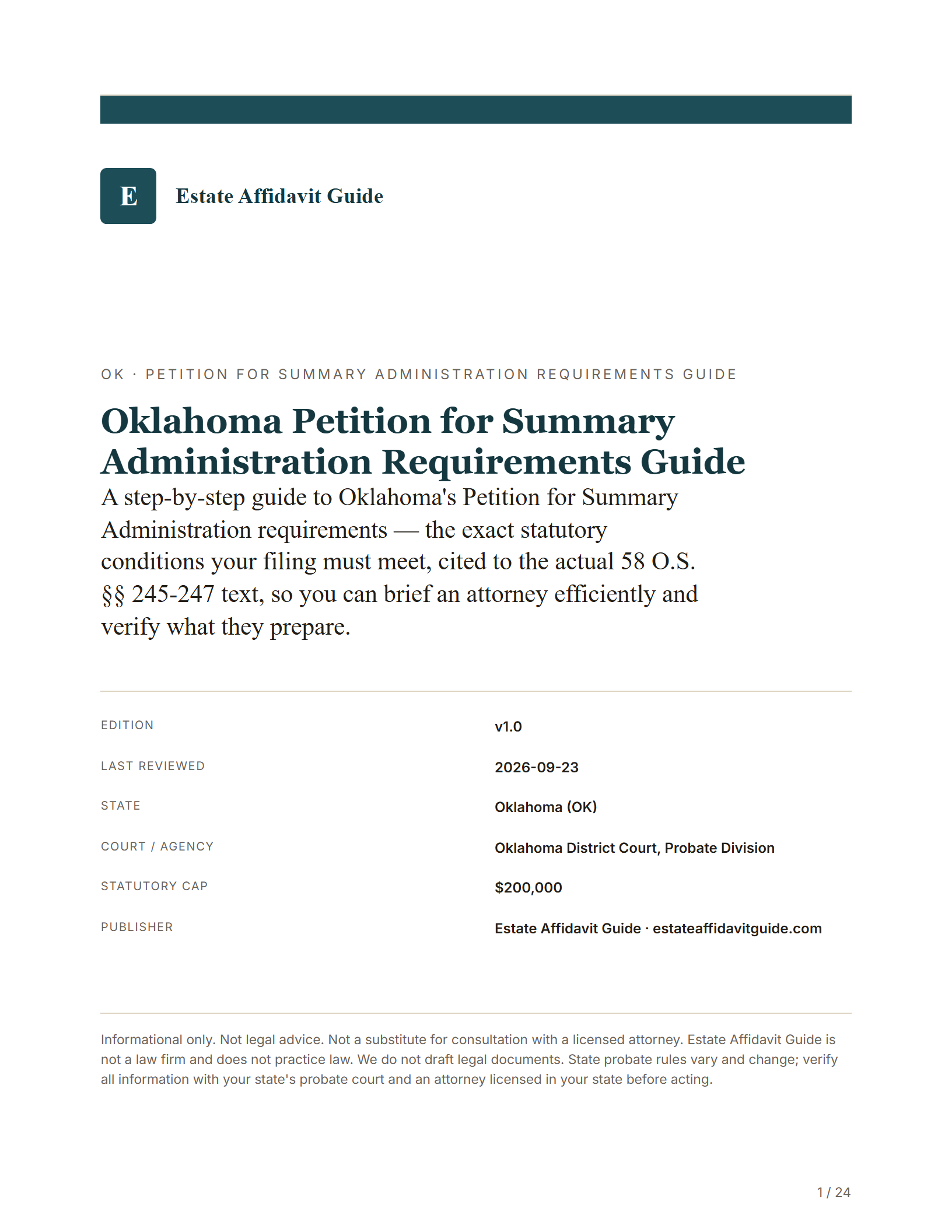
Cover & key facts
Version, last-reviewed date, the statutory cap, and the disclaimer — all on page 1.
View page -
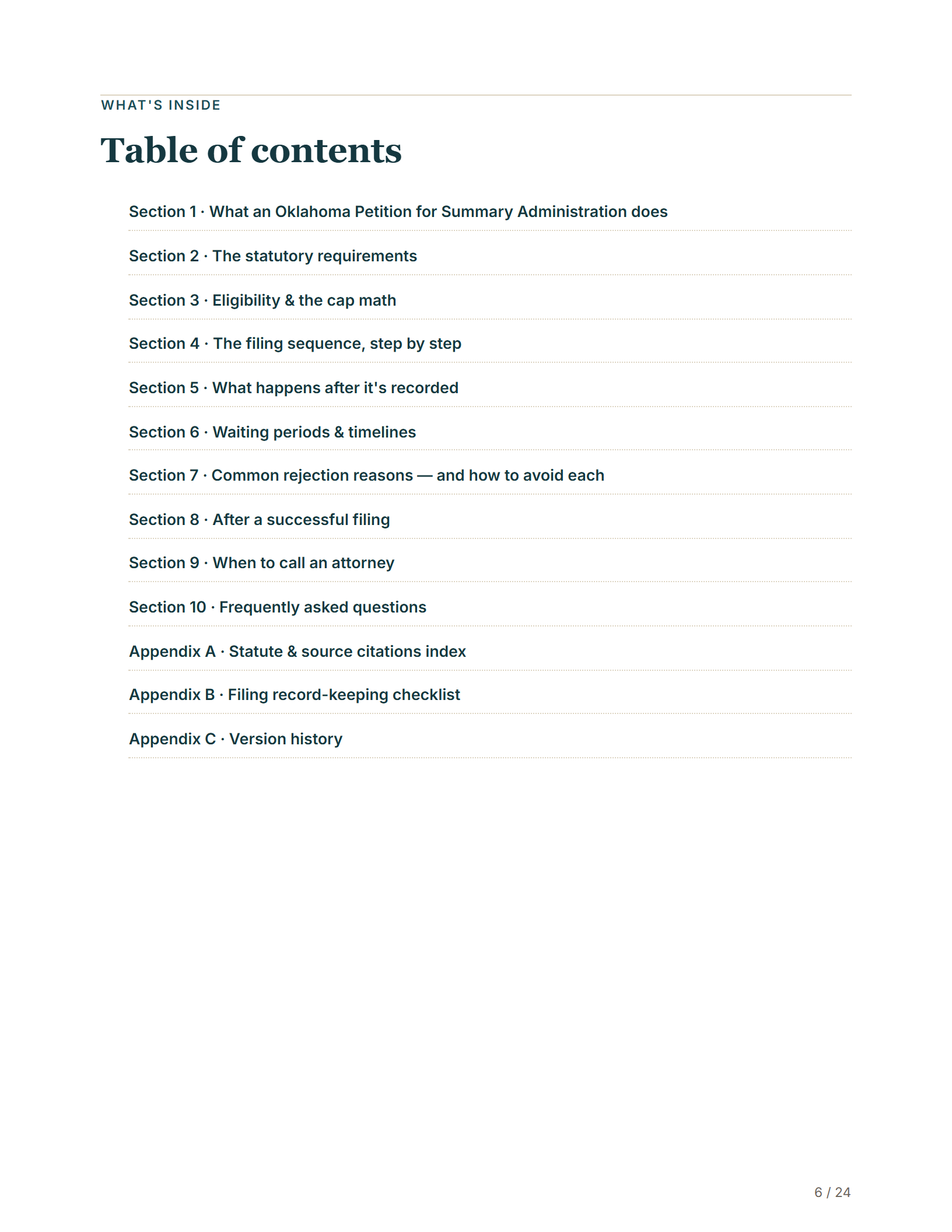
Table of contents
Every section in the order you'll use it — the eligibility check, the form walkthrough, and the bank-refusal script.
View page -
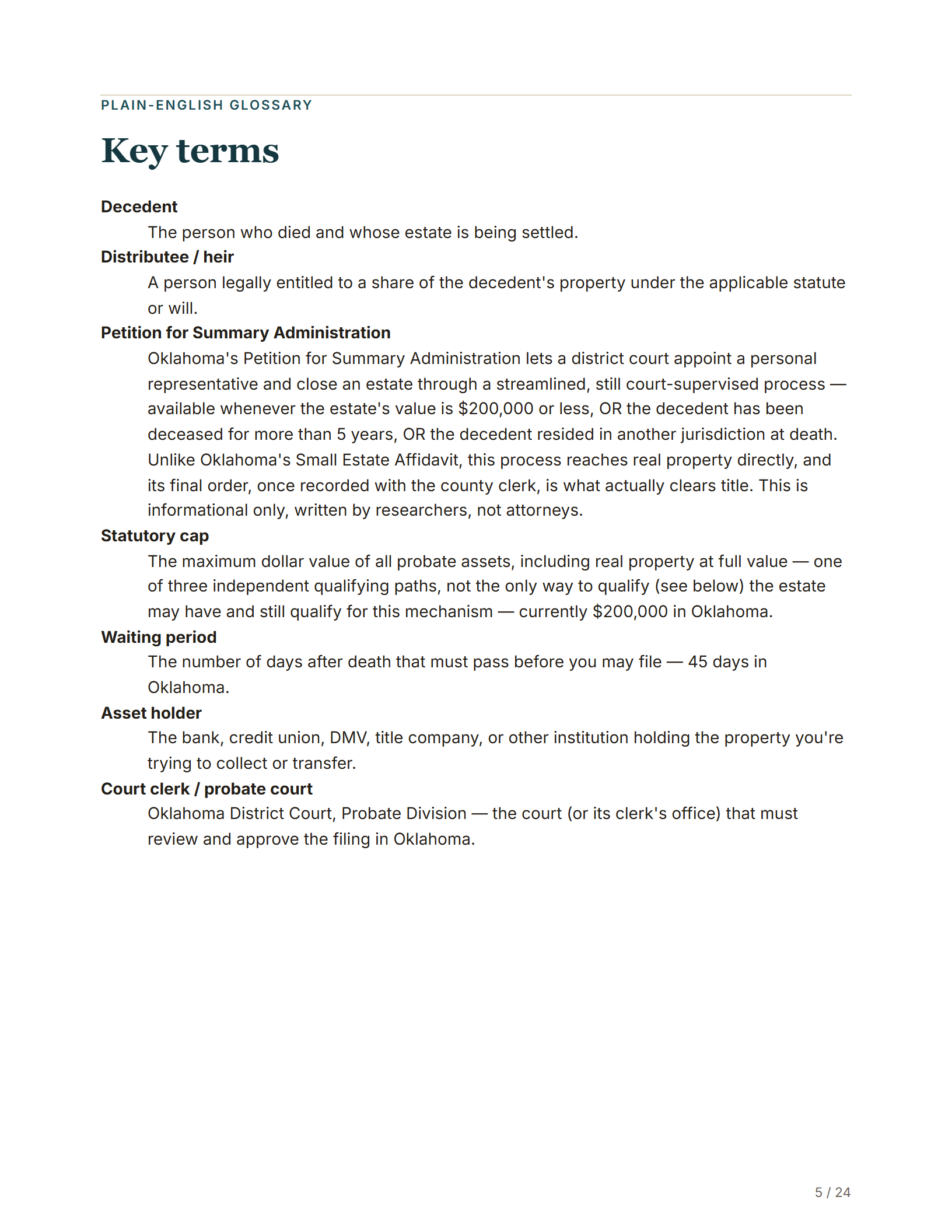
Plain-English glossary
Key terms translated for a non-attorney reader. The vocabulary the rest of the kit assumes.
View page -
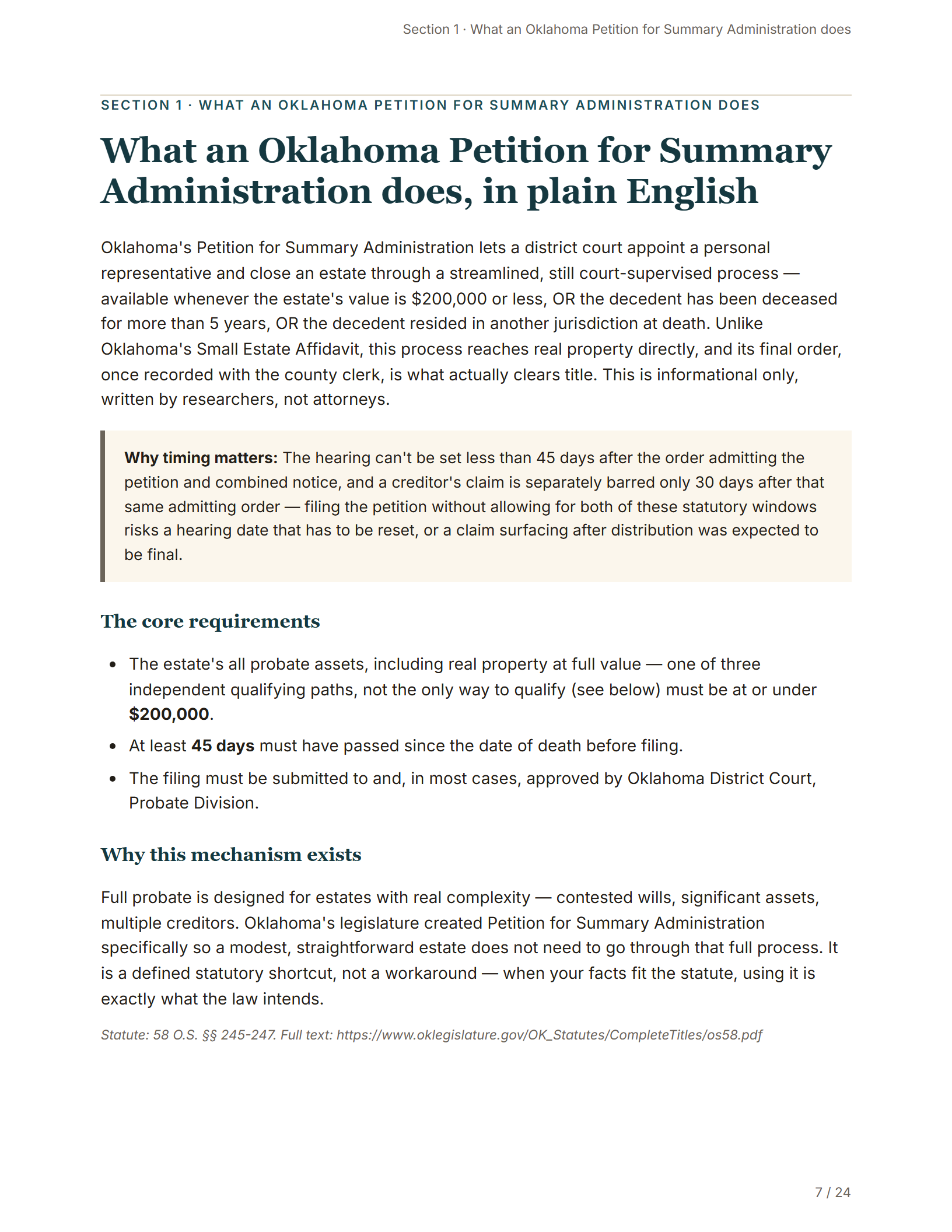
What it does, in plain English
The mechanism explained in plain language, cited to the statute, with your state's exact dollar cap built in.
View page -
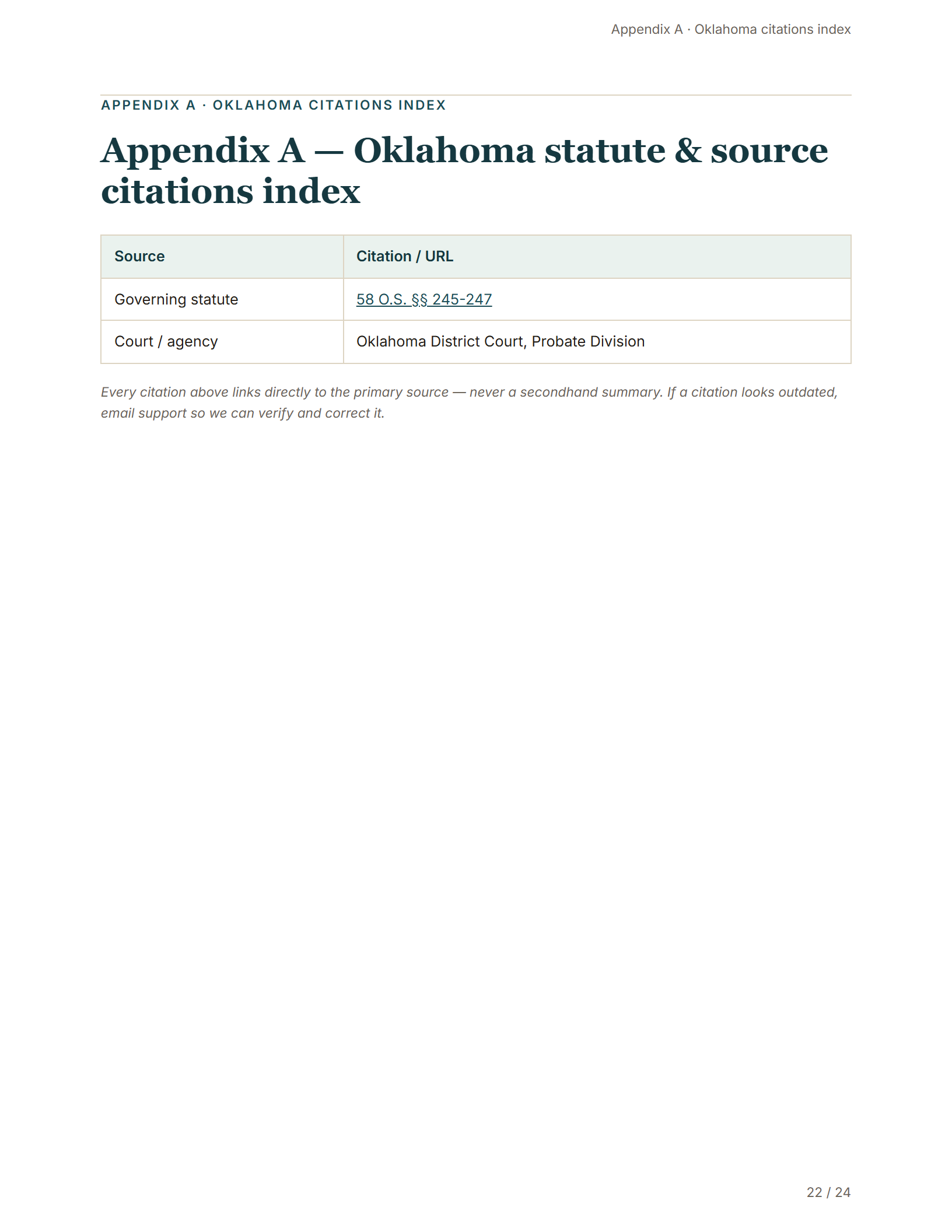
Citations index
Every operational claim sourced to the actual statute or official court/agency publication.
View page
Print-friendly, readable on a phone or tablet, and designed to be taken to the bank or clerk. Every operational claim cites the actual statute or official publication.
How this compares
Oklahoma doesn't publish a fill-in form for this mechanism, so an attorney drafts the filing either way. The $37 is for the guide — the requirements checklist and everything around it — that turns the attorney's job into drafting alone, instead of research-and-drafting on your bill.
| This guide | Attorney alone (no prep) | DIY research, no guide | Doing nothing | |
|---|---|---|---|---|
| Cost | $37 + attorney's drafting fee | $1,500–4,200+ (research + drafting) | $0 upfront — real risk of a rejected filing | Eventually full probate, if the estate is never settled |
| Time to filed | Faster — drafting only | 2–6 weeks (research + drafting) | Unpredictable | Not until you act |
| Bank/DMV/clerk pushback script | Yes | Sometimes | No | n/a |
| Statute citations | Yes | n/a | If you find them yourself | n/a |
| Delivery time | Instant (guide); attorney schedules separately | After consult + retainer | Instant, but unverified | n/a |
Attorney costs reflect typical Oklahoma probate-attorney retainers for this kind of filing.
The most-searched sticking point
What to do when a bank, DMV, or clerk pushes back
A facially valid filing still gets rejected on the first try more often than it should — usually because front-line staff have never processed one before, not because anything is actually wrong. This is the single biggest gap in every free state resource: none of them tell you what to actually say. The guide's Section 5 gives you the exact script and citation for each of these:
- An interested party files a timely objection before the hearing
- A title company or buyer won't treat the court's order alone as sufficient proof of clear title
Each one has a specific script and statutory citation behind it — not just "you're right, they're wrong," but exactly what to say and what document to hand over. That's in the guide.
If a bank, DMV, title company, or court clerk rejects your filing for a reason traceable to following this guide, you get a full refund.
Email the stated rejection reason to support@estateaffidavitguide.com within 30 days of purchase and we refund the full purchase price within one business day. No phone tag, no forms, no fight. Not covered: an estate that turns out to be over the dollar limit, a dispute among heirs, or a missing document unrelated to the filing itself. Changed your mind for any other reason? You have 7 days, no questions asked. Full refund policy.
Avoid these
4 common reasons filings get rejected
None of the three qualifying conditions is met
The petition omits a required statutory element
The closing hearing is set before the statutory 45-day minimum has run
A creditor's claim is filed after the 30-day bar date
Before you record the Oklahoma Petition for Summary Administration
The recorded filing isn't automatically the end of the story — a title company or other relying party can still ask for more. This free one-pager has the real scenarios that come up after recording and what resolves each, emailed now. We'll also send a few short follow-ups over the next few weeks — then we stop. No ongoing newsletter.
Questions
Frequently asked questions
Does an estate have to be under $200,000 to use Oklahoma's Petition for Summary Administration?
Can I file a Petition for Summary Administration without a lawyer?
How long does Oklahoma's summary administration actually take?
Does this process cover a house or other real property?
Is there a statutory attorney-fee schedule for this process?
What if someone objects to the petition?
Which Oklahoma mechanism applies to my situation?
Does Oklahoma have just one small estate process?
Ready to start?
$37, one time. Instant download. Money-back if your filing is rejected for a reason traceable to following the guide, or for any other reason within 7 days.
No waiting room, no retainer. The 45-day wait after death is fixed, but most of the remaining delay families hit is an avoidable rejection or a second trip back to the same bank, DMV, or clerk — this guide is built to help you avoid both on the first visit.
One last step — confirm below and it's instant from there.
Secure checkout by Stripe · Instant download · Money-back guarantee
Want a sibling or co-executor caught up? Send them what you just read.
Not ready to buy yet?
5 short, plain-English emails over the following weeks — the eligibility math, what to expect after the petition for summary administration is recorded, why most rejections are paperwork not eligibility, and when to call an attorney instead. Then we stop. No ongoing newsletter, no sales list. Unsubscribe anytime.
Primary sources
State sources
Every claim here cites the actual statute or an official publication — see them
- Statute: 58 O.S. §§ 245-247 . The primary source behind every requirement, cap, and deadline described above.