Ohio Summary Release from Administration
If a bank told you an account is frozen and didn't explain what that actually means, you're not stuck, and you're not the only one this has happened to. A probate attorney would typically charge $1,500–$4,200+ to walk you through exactly what Ohio law already lets you do yourself. This kit is $37, one-time, and covers the same ground — the eligibility rule, the official form, and what to say if a bank or clerk pushes back.
Ohio's summary release from administration — R.C. 2113.031, filed on the Supreme Court's Form 5.10 in the probate court — is the smallest court shortcut Ohio offers. A person who paid the funeral can use it when the whole estate is no more than the lesser of $5,000 or the funeral bill, and a surviving spouse can use it up to the $40,000 allowance for support plus up to $5,000 of funeral expenses. The court issues an order that lets banks and title offices transfer assets to the applicant; Ohio Legal Help says it takes about one to two weeks. This is informational only, written by researchers, not attorneys.
Last reviewed
Ohio has more than one probate-avoidance mechanism. See the Release from Administration guide instead → · See the Survivorship Affidavit guide instead →
- Built on the official state form
- Every claim cited to R.C. 2113.031
- Secure checkout by Stripe
- Money-back if the affidavit is rejected
Splitting up the estate with someone else? Send them this page before you start.
Why timing matters: The order covers only the assets listed in the application, and the court must find there are no other known assets (R.C. 2113.031(C)(5)). An asset found later needs a supplemental filing with its own fee, and the total must stay under the limit — so list everything the first time. If Ohio's Medicaid estate recovery program applies, its notice is due within 30 days of filing (R.C. 2117.061(B)). Miss the window and the estate is generally pushed into full probate instead — a probate attorney typically charges $1,500–$4,200+ for work this kit is built to help you avoid.
The Ohio $5,000 Summary Release from Administration cap
Filing Summary Release from Administration in Ohio starts with one number — the statutory cap. The estate, measured the way the statute measures it, has to be at or under $5,000 (probate assets, where the limit is the lesser of $5,000 or the funeral bill for a non-spouse who paid the funeral, and $40,000 plus up to $5,000 of funeral costs for a surviving spouse), under R.C. 2113.031. This is a statutory line, not a judgment call — the court or asset holder either sees the total under the cap or they don't. Summary Release from Administration is filed with the court, not handed directly to a bank or DMV. Ohio publishes an official fill-in form: The Ohio Supreme Court publishes Form 5.10, "Application for Summary Release from Administration" (effective March 1, 2008), and Form 5.11, "Entry Granting Summary Release from Administration" (7/9/01). R.C. 2113.031(C)(2)(b) requires the application to be in the form the Supreme Court prescribes, and signed and acknowledged before a notary public or a deputy clerk of the probate court. Counties post their own current copies and add forms (Form 1.0 listing the heirs; Form 12.0/12.1 for land; a Medicaid estate recovery form), so use your own probate court's packet. .
How to file, step by step
- 1
Work out which applicant you are
A person who is not a surviving spouse and who paid, or is obligated in writing to pay, the funeral and burial expenses may apply if the assets are no more than the lesser of $5,000 or those expenses. A surviving spouse may apply, if funeral expenses are prepaid or the spouse paid or is obligated to pay them, up to the $40,000 allowance plus up to $5,000 of funeral expenses (R.C. 2113.031(B)).
- 2
Total the assets against the limit
Add the date-of-death value of everything in the estate that would go through probate. For a non-spouse, compare it with the lesser of $5,000 or the funeral bill (Cuyahoga's guide: assets of $3,200 and a $4,900 funeral qualify, assets of $4,900 and a $3,200 funeral do not). For a spouse, compare it with $40,000 plus up to $5,000.
- 3
Confirm nothing else is open
There must be no pending administration and no pending release application, and no known assets beyond those you will list (R.C. 2113.031(C)(4)-(5)).
- 4
Gather the documents
A certified death certificate, the funeral bill and proof that you paid or are obligated in writing to pay it (a spouse with a prepaid funeral shows the prepayment), titles and VINs for vehicles, account statements with full numbers, details for stocks and bonds, and for land the deed and a certificate-of-transfer application.
- 5
Get your county's current forms
Download Form 5.10 and the entry (Form 5.11) from the probate court of the county where the decedent lived, with Form 1.0 listing the surviving spouse and heirs, and Form 12.0/12.1 if land is included. Check the checklist for a Medicaid recovery form. View source →
- 6
Complete Form 5.10
State the date of death and domicile, check the box that matches you, attach the funeral proof, state that there are no pending proceedings, and list every known asset with its date-of-death value.
- 7
Sign before a notary or a deputy clerk
The applicant signs and acknowledges the application before a notary public or a deputy clerk of the probate court (R.C. 2113.031(C)(2)(c)).
- 8
File with the fee and send any Medicaid notice
File with the probate court and pay the fee: the statute sets $60 (R.C. 2101.16(A)(59)), and counties charge more in total. If the Medicaid estate recovery program applies, send its notice form within 30 days of filing (R.C. 2117.061).
- 9
Get the entry and certified copies of both papers
If the court finds every requirement met it issues the entry; Ohio Legal Help says processing takes about one to two weeks. Order certified copies of the entry and of the application — a holder needs both (R.C. 2113.031(E)).
- 10
Present them to each holder and the offices for land and vehicles
Give the certified order and application to each bank or other holder and to the clerk of courts' title office for a vehicle. Take any certificate of transfer to the county auditor and then the recorder. If you later find another asset, a supplemental summary release is allowed only while the total stays under the limit.
What it actually looks like
Sample pages from the kit
Real pages from the Ohio kit PDF. Click any page to enlarge.
-
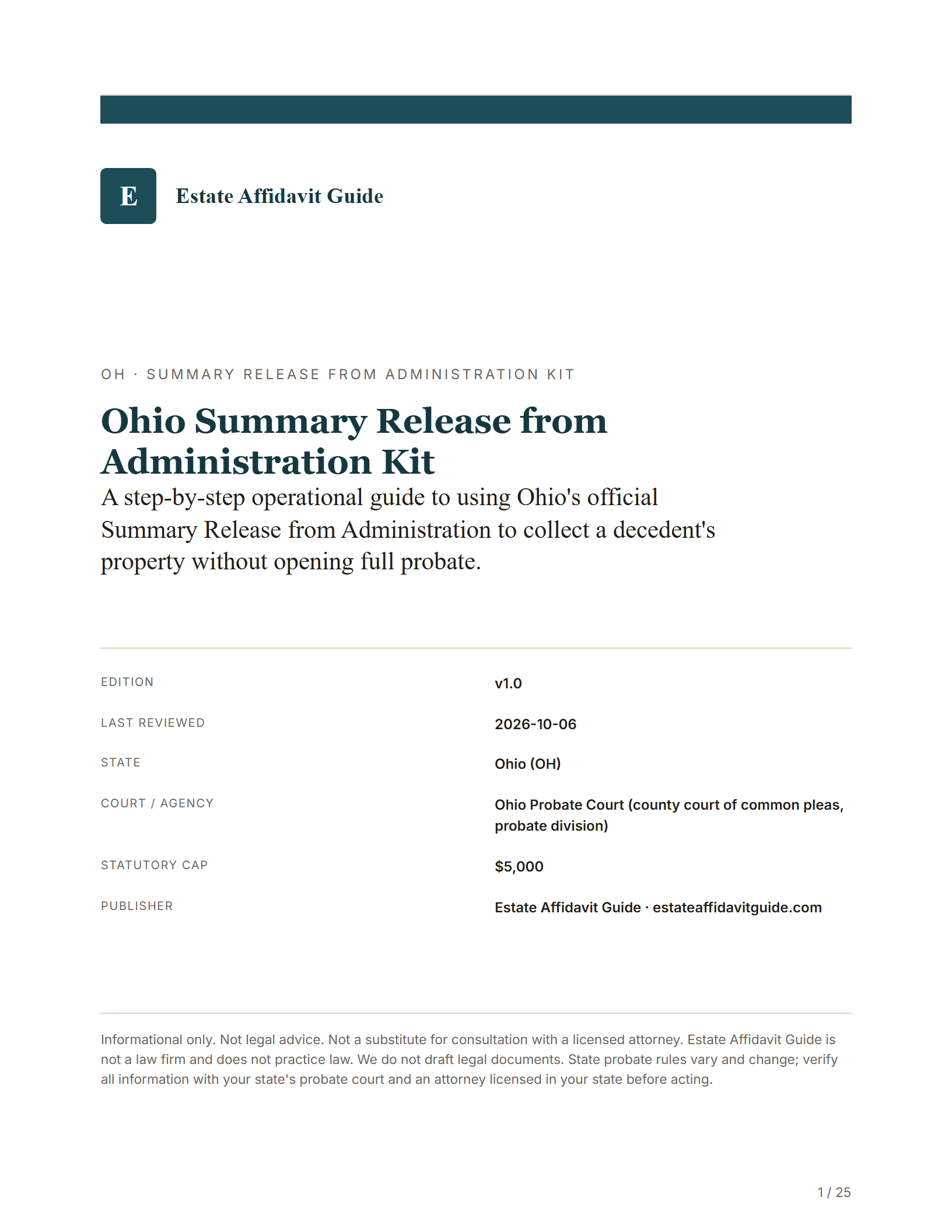
Cover & key facts
Version, last-reviewed date, the statutory cap, and the disclaimer — all on page 1.
View page -
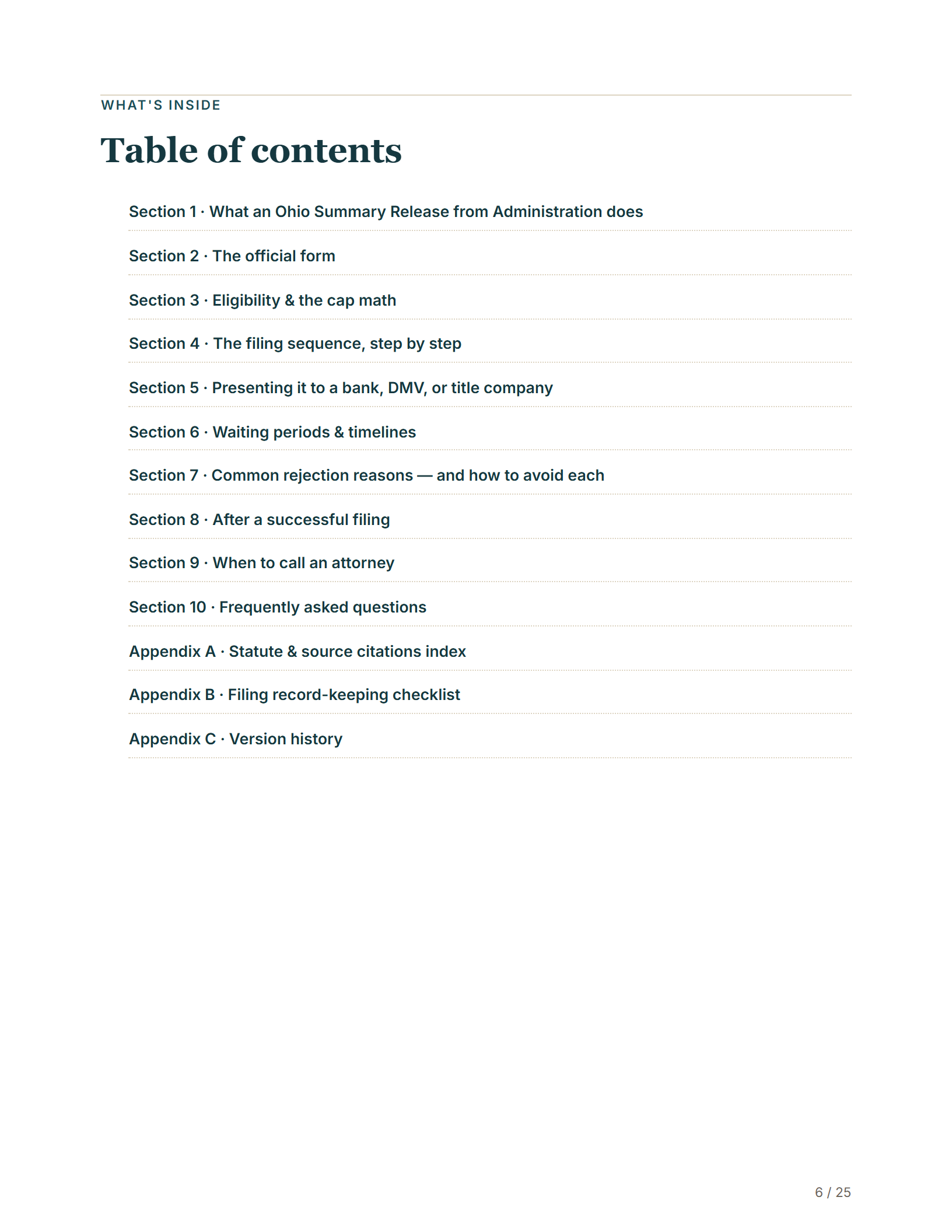
Table of contents
Every section in the order you'll use it — the eligibility check, the form walkthrough, and the bank-refusal script.
View page -
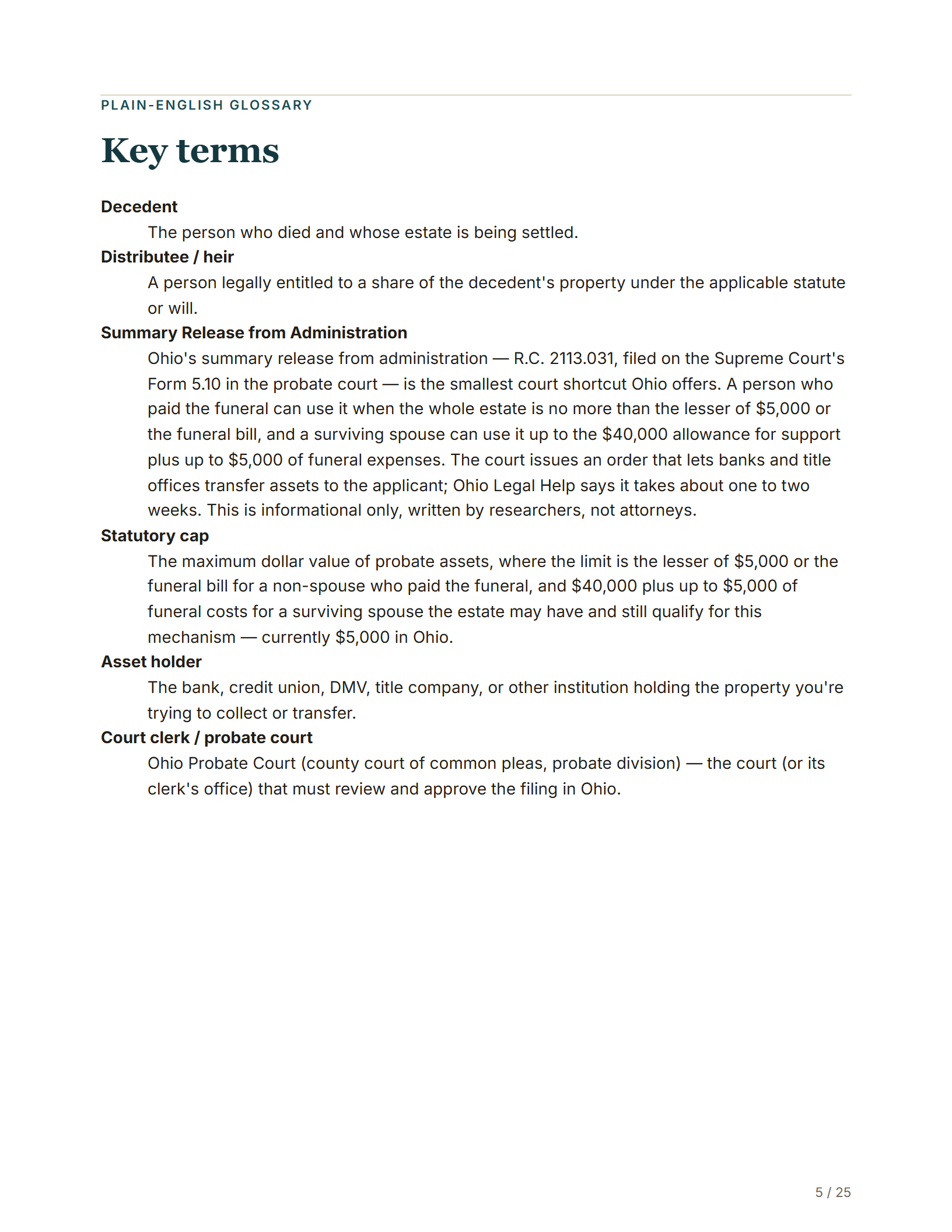
Plain-English glossary
Key terms translated for a non-attorney reader. The vocabulary the rest of the kit assumes.
View page -
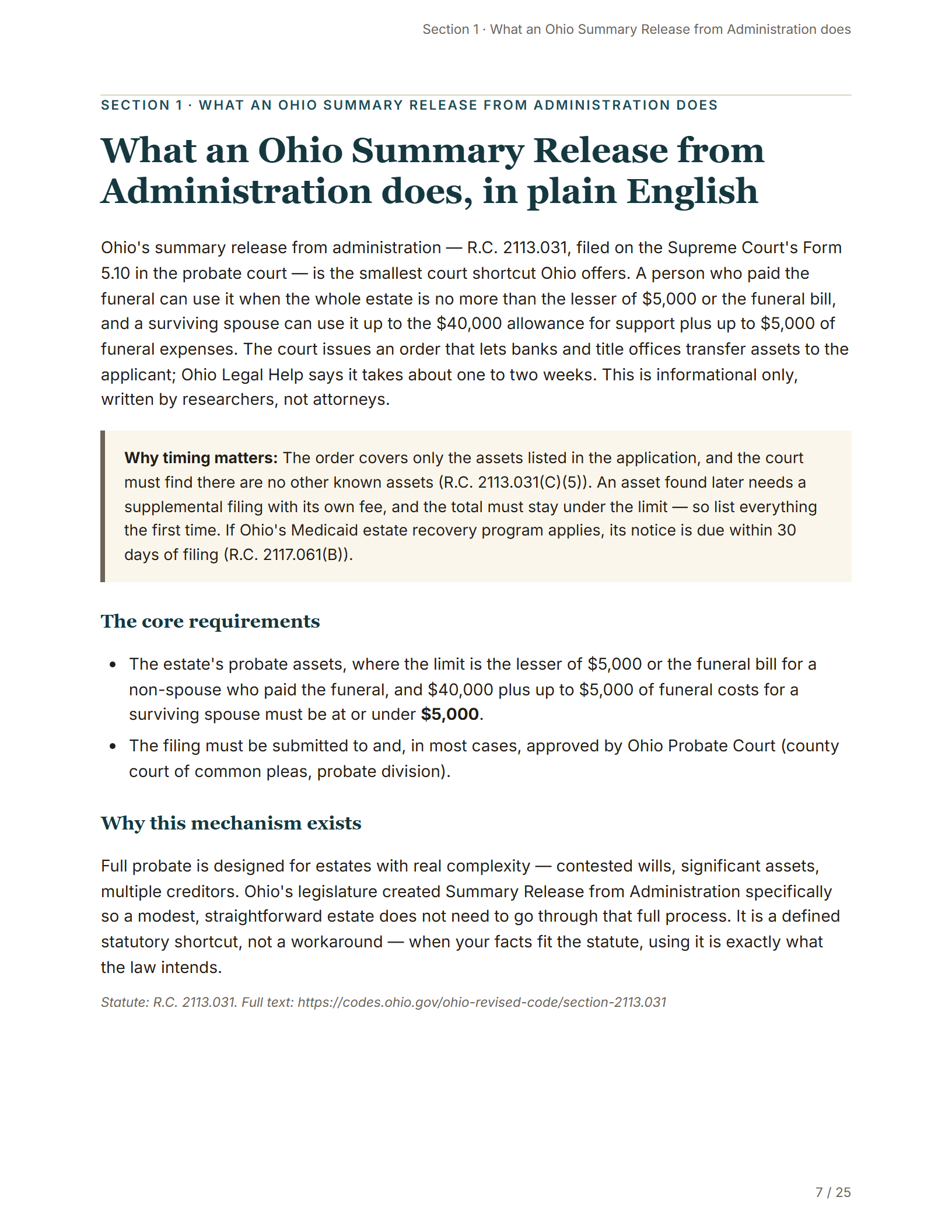
What it does, in plain English
The mechanism explained in plain language, cited to the statute, with your state's exact dollar cap built in.
View page -
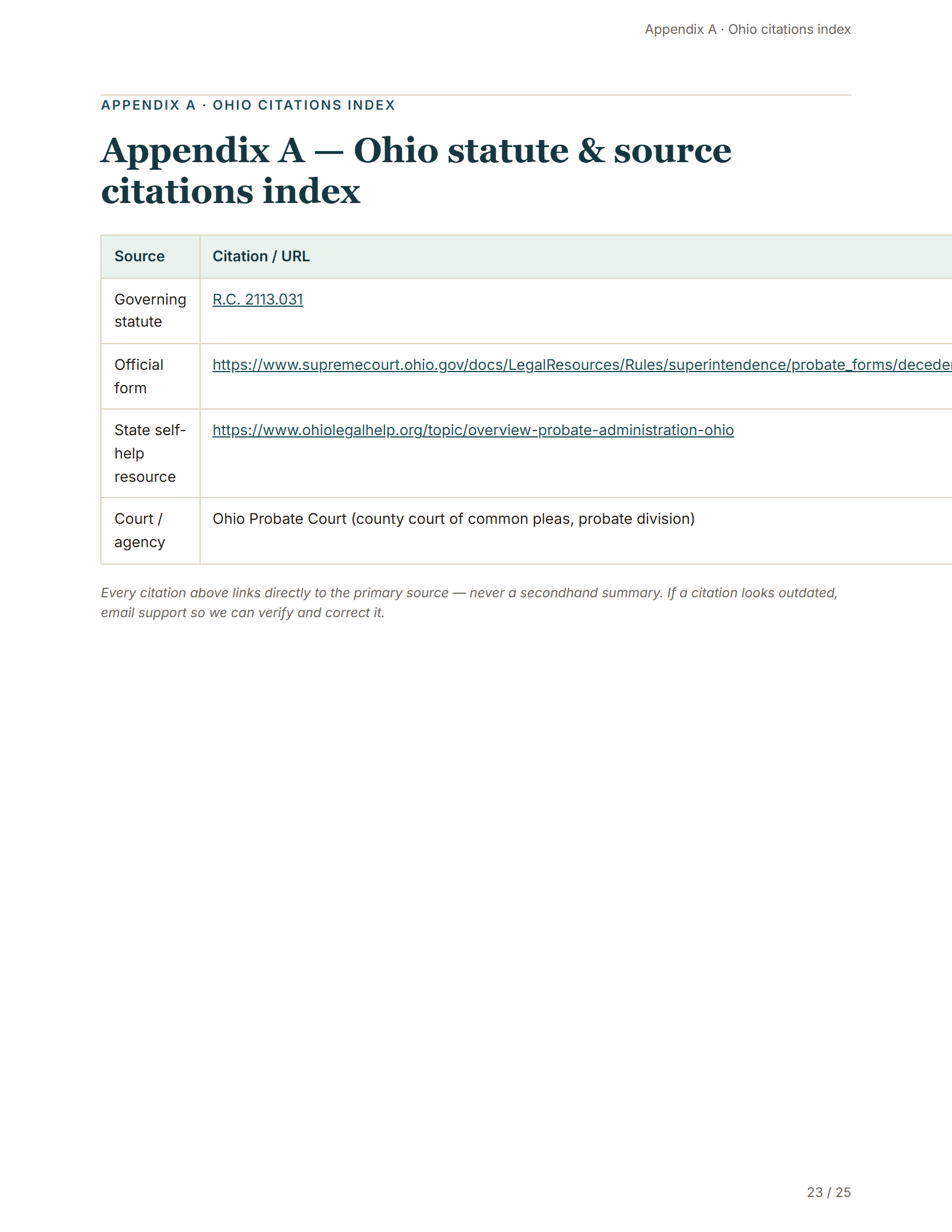
Citations index
Every operational claim sourced to the actual statute or official court/agency publication.
View page
Print-friendly, readable on a phone or tablet, and designed to be taken to the bank or clerk. Every operational claim cites the actual statute or official publication.
How this compares
Yes — Ohio's own form is free (that's the Free state form column below). The $37 is for everything the free form leaves you to work out alone: the eligibility check, the filing sequence, and what to do when a bank, DMV, or clerk pushes back.
| This kit | Probate attorney | Free state form | Doing nothing | |
|---|---|---|---|---|
| Cost | $37 | $1,500–4,200+ | $0 | Eventually full probate, if the estate is never settled |
| Time to filed | Same week to prepare; court approval timing varies by county | 2–6 weeks | If you can decode it alone | Not until you act |
| Bank/DMV/clerk pushback script | Yes | Sometimes | No | n/a |
| Statute citations | Yes | n/a | n/a | n/a |
| Delivery time | Instant download | After consult + retainer | Instant | n/a |
Attorney costs reflect typical Ohio probate-attorney retainers for this kind of filing.
The most-searched sticking point
What to do when a bank, DMV, or clerk pushes back
A facially valid filing still gets rejected on the first try more often than it should — usually because front-line staff have never processed one before, not because anything is actually wrong. This is the single biggest gap in every free state resource: none of them tell you what to actually say. The kit's Section 5 gives you the exact script and citation for each of these:
- A bank or other holder says it needs Letters of Authority
- The holder says an asset was not in the order
- The title office or the auditor will not transfer without more
- The court says you do not qualify as a surviving spouse
- Application returned for funeral proof, notarization, or the Medicaid notice
Each one has a specific script and statutory citation behind it — not just "you're right, they're wrong," but exactly what to say and what document to hand over. That's in the kit.
If a bank, DMV, title company, or court clerk rejects your filing for a reason traceable to following this kit, you get a full refund.
Email the stated rejection reason to support@estateaffidavitguide.com within 30 days of purchase and we refund the full purchase price within one business day. No phone tag, no forms, no fight. Not covered: an estate that turns out to be over the dollar limit, a dispute among heirs, or a missing document unrelated to the filing itself. Changed your mind for any other reason? You have 7 days, no questions asked. Full refund policy.
Avoid these
6 common reasons filings get rejected
The estate is over the limit for the person applying
The applicant did not pay, or is not obligated in writing to pay, the funeral
The surviving spouse does not qualify under the statute's definition
An administration or a release application is already pending
The application leaves out known assets or required detail
Land is included but no certificate-of-transfer application is attached
Before you present the Ohio Summary Release from Administration
Most rejected-on-the-first-try filings are a front-line-staff problem, not an eligibility problem. This free one-pager has what to bring and what to say the first time you hand it to a bank, DMV, or clerk — emailed now. We'll also send a few short follow-ups over the next few weeks (why most pushback is unfamiliarity not law, the exact citation to point to, when to call an attorney) — then we stop. No ongoing newsletter.
Questions
Frequently asked questions
What is a summary release from administration in Ohio?
Who can apply?
What are the limits?
Is there a hearing or a waiting period?
What does the order let me do?
Can it include a house?
What does it cost?
Can I file more than once?
Do I have to notify Medicaid?
How is this different from a release from administration?
Which Ohio filing applies to my situation?
Does Ohio have a small estate affidavit?
Is an Ohio "affidavit of heirship" the same thing?
Can I get the title to a house with a certificate of transfer alone?
What about a transfer-on-death deed or affidavit?
Does Ohio require a lawyer for these filings?
Ready to start?
$37, one time. Instant download. Money-back if your filing is rejected for a reason traceable to following the kit, or for any other reason within 7 days.
No waiting room, no retainer. Most of the remaining delay families hit is an avoidable rejection or a second trip back to the same bank, DMV, or clerk — this kit is built to help you avoid both on the first visit.
One last step — confirm below and it's instant from there.
Secure checkout by Stripe · Instant download · Money-back guarantee
Want a sibling or co-executor caught up? Send them what you just read.
Not ready to buy yet?
5 short, plain-English emails over the following weeks — the eligibility math, the summary release from administration presentation moment, why most rejections are paperwork not eligibility, and when to call an attorney instead. Then we stop. No ongoing newsletter, no sales list. Unsubscribe anytime.
Primary sources
State sources
Every claim here cites the actual statute or an official publication — see them
- Statute: R.C. 2113.031 . The primary source behind every requirement, cap, and deadline described above.
- Official form: Official Summary Release from Administration form The Ohio Supreme Court publishes Form 5.10, "Application for Summary Release from Administration" (effective March 1, 2008), and Form 5.11, "Entry Granting Summary Release from Administration" (7/9/01). R.C. 2113.031(C)(2)(b) requires the application to be in the form the Supreme Court prescribes, and signed and acknowledged before a notary public or a deputy clerk of the probate court. Counties post their own current copies and add forms (Form 1.0 listing the heirs; Form 12.0/12.1 for land; a Medicaid estate recovery form), so use your own probate court's packet.
- State self-help resource: Ohio Probate Court (county court of common pleas, probate division)