Indiana Devolution Affidavit
If a bank told you an account is frozen and didn't explain what that actually means, you're not stuck, and you're not the only one this has happened to. A probate attorney would typically charge $1,500–$4,200+ to walk you through exactly what Indiana law already lets you do yourself. This guide is $37, one-time, and covers the same ground — the eligibility rule, the official form, and what to say if a bank or clerk pushes back.
When a deceased Indiana resident's real property passes to their heirs or beneficiaries, Indiana Code § 29-1-7-23 lets a distributee record a sworn devolution affidavit with the county recorder — establishing evidence of who inherited the property, with no dollar cap and no court proceeding, once seven months have passed since death. This is Indiana's version of what other states often call an affidavit of heirship, though Indiana law and practitioners call it a devolution affidavit. This is informational only, written by researchers, not attorneys.
Last reviewed
Indiana has more than one probate-avoidance mechanism. See the Small Estate Affidavit guide instead →
- Built on the statutory requirements, not a guess
- Every claim cited to Indiana Code § 29-1-7-23
- Secure checkout by Stripe
- Money-back if the filing is rejected
Splitting up the estate with someone else? Send them this page before you start.
Why timing matters: A 2020 law change lets this affidavit be filed before the seven-month mark, but it only counts as evidence of effective title transfer once seven months have actually passed since death with no personal representative appointed — relying on it too early risks the very disruption that waiting period exists to prevent, especially if a family is trying to sell or refinance the property. Miss the window and the estate is generally pushed into full probate instead — a probate attorney typically charges $1,500–$4,200+ for work this guide is built to help you avoid.
Indiana's Devolution Affidavit — no dollar cap
Indiana's Devolution Affidavit has no dollar ceiling — eligibility instead turns on the specific conditions Indiana Code § 29-1-7-23 sets out. There's no total to add up before you know whether it applies. Devolution Affidavit is recorded at the county level — not filed with a court and not presented directly to a bank or DMV. Indiana does not publish a fill-in form for this mechanism — see the how-to-file guide below for what the statute requires instead.
How to file, step by step
- 1
Confirm the property is real estate, and confirm how title passed
This mechanism only reaches real property (a house, land, or similar real estate interest) — it does not apply to personal property, which is Indiana's separate small estate affidavit's territory. Title must have passed either by intestate succession or by a will that has already been admitted to probate; a valid will that was never probated generally isn't covered.
- 2
Identify every known distributee and calculate fractional interests
The affidavit must name every known distributee and, if more than one, show how their fractional interests in the property are calculated.
- 3
Gather the chain of title and legal description
The affidavit must show the deed or instrument history that vested record title in the decedent, plus the property's full legal description — not just a street address.
- 4
Prepare the affidavit covering all required statutory elements
Indiana Code § 29-1-7-23(b) requires: the decedent's name and date of death; the affiant's relationship to the decedent; the deed history vesting title in the decedent; the legal description; the names of all known distributees; how title passed (intestate, or by an admitted will, naming the probate court and cause number); and any fractional-interest calculation.
- 5
Consider the timing carefully before recording
The affidavit can be filed before seven months have passed since a 2020 statutory change, but it is only relied upon as prima facie evidence of effective title transfer once seven months have actually elapsed and no personal representative has been appointed. Filing earlier is now procedurally allowed, but waiting until the seven-month mark to actually rely on it for a sale or transfer is often the more practical approach.
- 6
Record the affidavit with the county recorder
Unlike the small estate affidavit, this is filed with the county recorder in the county where the property is located — not presented to a bank or other asset holder. The recorder indexes it as the most recent title-transfer instrument, and the county auditor separately endorses it as exempt from sales-disclosure requirements and updates the tax duplicate with the distributees' names.
- 7
If a title company hesitates, point to the prima facie evidence provision
Indiana Code § 29-1-7-23(e) makes a good-faith recorded affidavit prima facie evidence of effective title transfer once the seven-month/no-personal-representative conditions are met — this is the statute's own answer to a title professional's caution, not a workaround.
What it actually looks like
Sample pages from the guide
Real pages from the Indiana guide PDF. Click any page to enlarge.
-
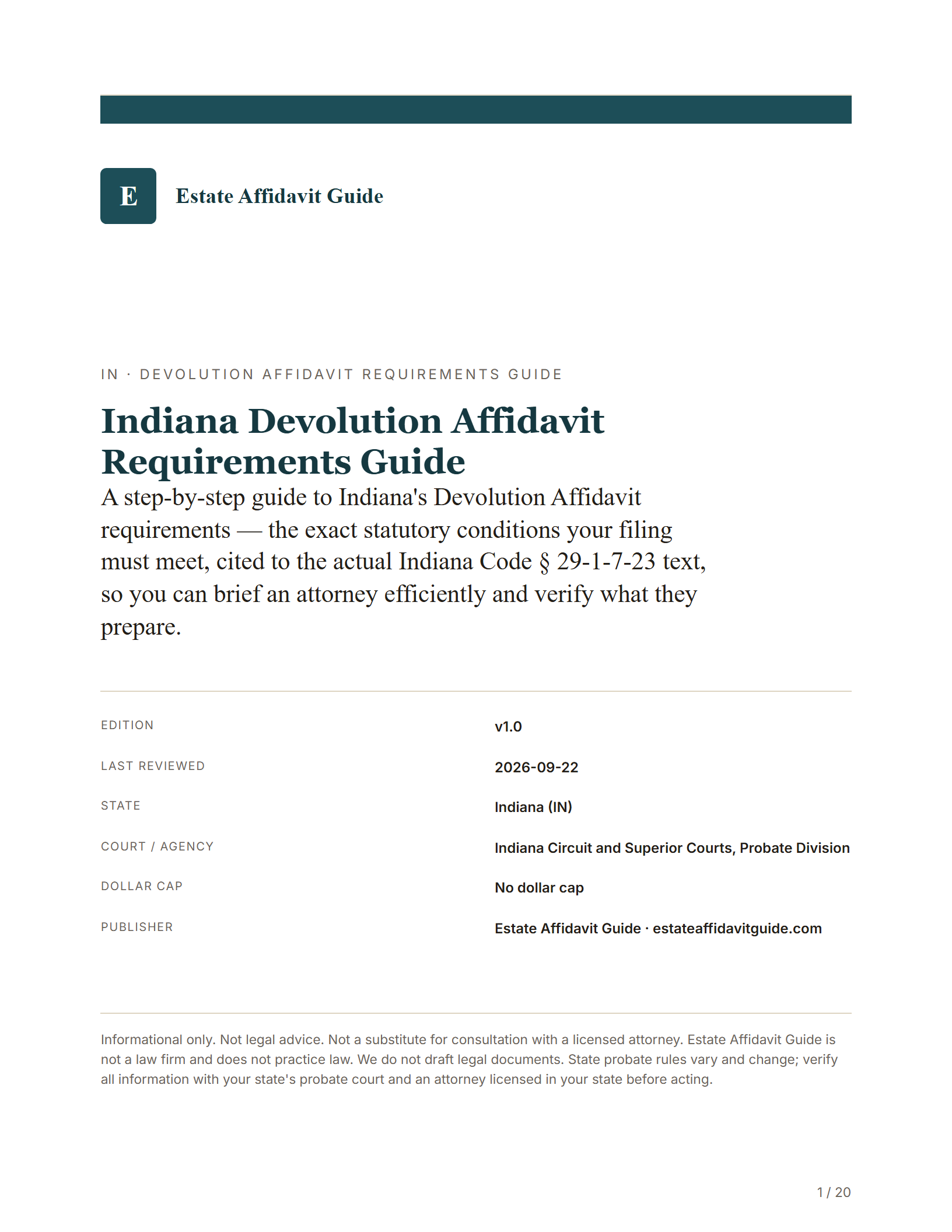
Cover & key facts
Version, last-reviewed date, the statutory cap, and the disclaimer — all on page 1.
View page -

Table of contents
Every section in the order you'll use it — the eligibility check, the form walkthrough, and the bank-refusal script.
View page -
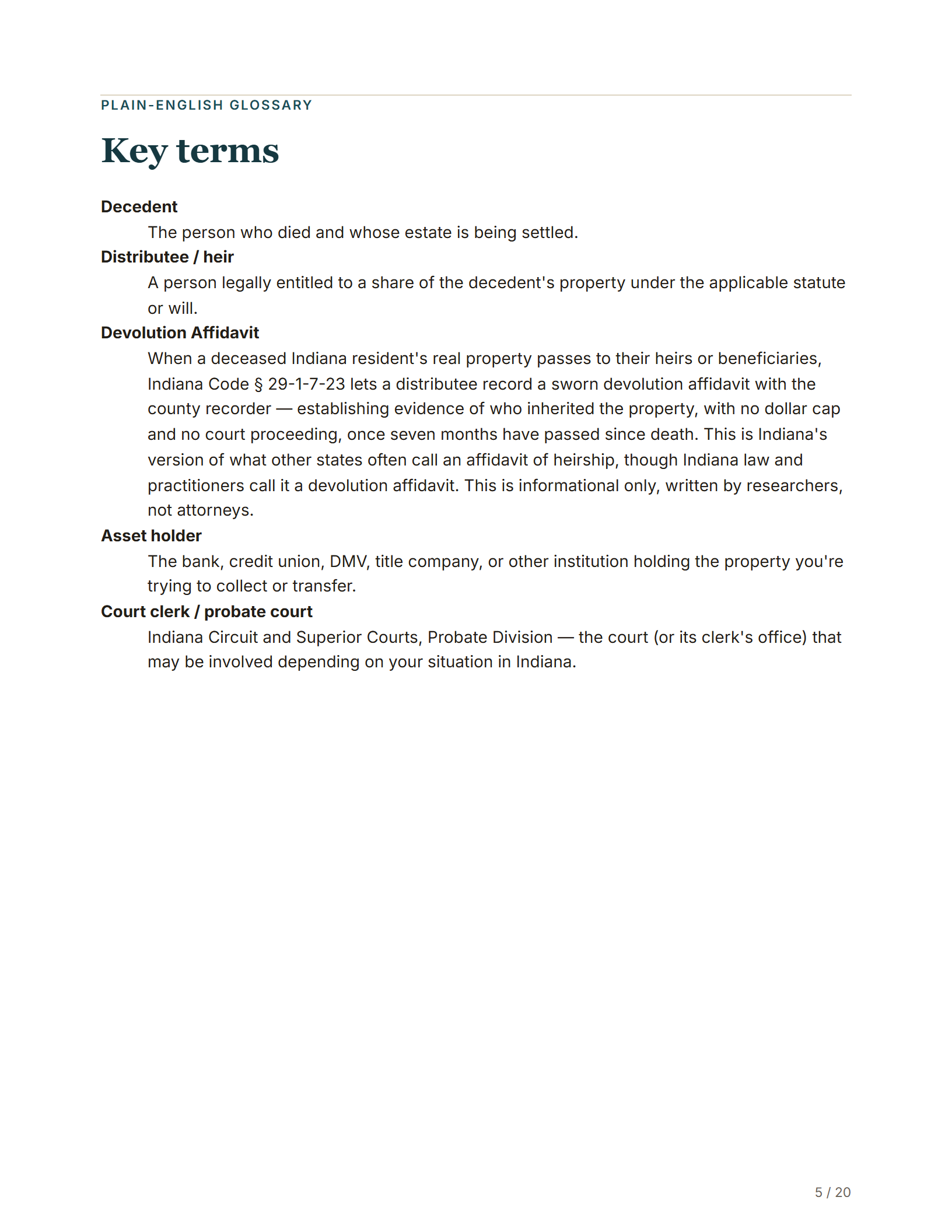
Plain-English glossary
Key terms translated for a non-attorney reader. The vocabulary the rest of the kit assumes.
View page -
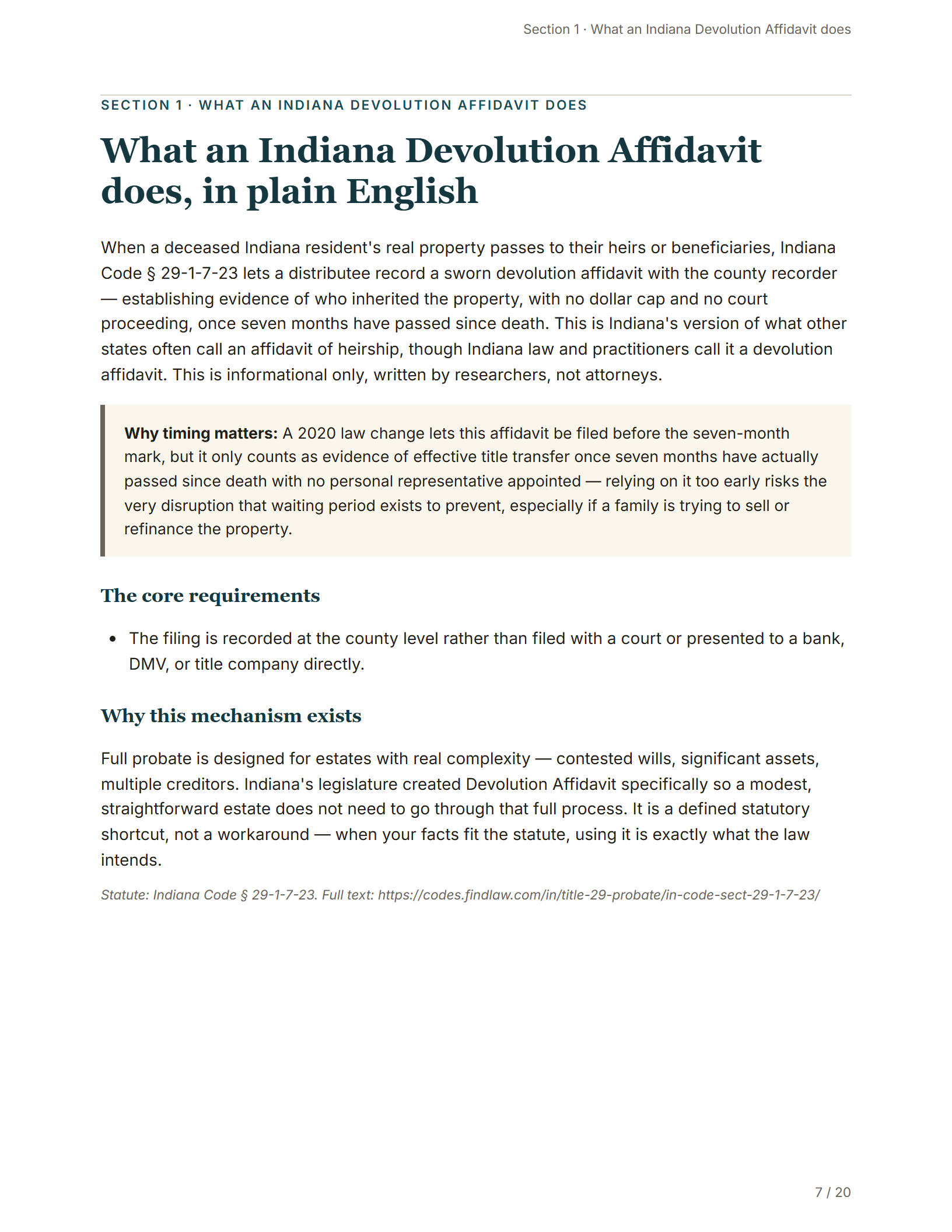
What it does, in plain English
The mechanism explained in plain language, cited to the statute, with your state's exact dollar cap built in.
View page -
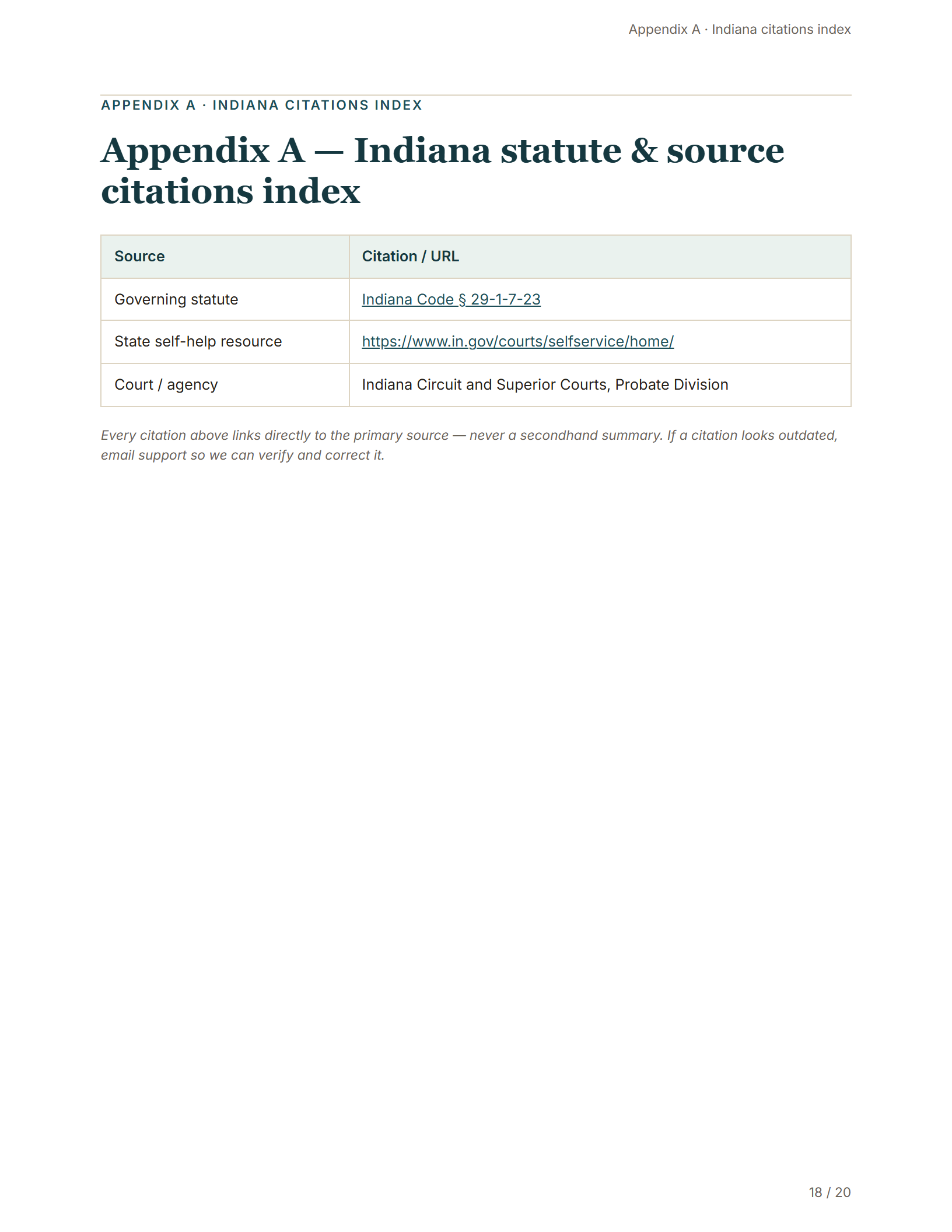
Citations index
Every operational claim sourced to the actual statute or official court/agency publication.
View page
Print-friendly, readable on a phone or tablet, and designed to be taken to the bank or clerk. Every operational claim cites the actual statute or official publication.
How this compares
Indiana doesn't publish a fill-in form for this mechanism, so an attorney drafts the filing either way. The $37 is for the guide — the requirements checklist and everything around it — that turns the attorney's job into drafting alone, instead of research-and-drafting on your bill.
| This guide | Attorney alone (no prep) | DIY research, no guide | Doing nothing | |
|---|---|---|---|---|
| Cost | $37 + attorney's drafting fee | $1,500–4,200+ (research + drafting) | $0 upfront — real risk of a rejected filing | Eventually full probate, if the estate is never settled |
| Time to filed | Faster — drafting only | 2–6 weeks (research + drafting) | Unpredictable | Not until you act |
| Bank/DMV/clerk pushback script | Yes | Sometimes | No | n/a |
| Statute citations | Yes | n/a | If you find them yourself | n/a |
| Delivery time | Instant (guide); attorney schedules separately | After consult + retainer | Instant, but unverified | n/a |
Attorney costs reflect typical Indiana probate-attorney retainers for this kind of filing.
The most-searched sticking point
What to do when a bank, DMV, or clerk pushes back
A facially valid filing still gets rejected on the first try more often than it should — usually because front-line staff have never processed one before, not because anything is actually wrong. This is the single biggest gap in every free state resource: none of them tell you what to actually say. The guide's Section 5 gives you the exact script and citation for each of these:
- Title company or realtor hesitates to rely on the affidavit
Each one has a specific script and statutory citation behind it — not just "you're right, they're wrong," but exactly what to say and what document to hand over. That's in the guide.
If a bank, DMV, title company, or court clerk rejects your filing for a reason traceable to following this guide, you get a full refund.
Email the stated rejection reason to support@estateaffidavitguide.com within 30 days of purchase and we refund the full purchase price within one business day. No phone tag, no forms, no fight. Not covered: an estate that turns out to be over the dollar limit, a dispute among heirs, or a missing document unrelated to the filing itself. Changed your mind for any other reason? You have 7 days, no questions asked. Full refund policy.
Avoid these
3 common reasons filings get rejected
A valid will exists but has not been admitted to probate
Fewer than seven months have passed since death
Family disagreement exists over who the heirs actually are
Before you record the Indiana Devolution Affidavit
The recorded filing isn't automatically the end of the story — a title company or other relying party can still ask for more. This free one-pager has the real scenarios that come up after recording and what resolves each, emailed now. We'll also send a few short follow-ups over the next few weeks — then we stop. No ongoing newsletter.
Questions
Frequently asked questions
Is a devolution affidavit the same thing as an affidavit of heirship?
Is there a dollar limit on a devolution affidavit?
How long do I have to wait before using a devolution affidavit?
Does a devolution affidavit work if the decedent left a will?
What if the title company won't accept the affidavit?
Which Indiana mechanism applies to my situation?
Does Indiana call this a 'small estate affidavit' like most other states?
Ready to start?
$37, one time. Instant download. Money-back if your filing is rejected for a reason traceable to following the guide, or for any other reason within 7 days.
No waiting room, no retainer. Most of the remaining delay families hit is an avoidable rejection or a second trip back to the same bank, DMV, or clerk — this guide is built to help you avoid both on the first visit.
One last step — confirm below and it's instant from there.
Secure checkout by Stripe · Instant download · Money-back guarantee
Want a sibling or co-executor caught up? Send them what you just read.
Not ready to buy yet?
5 short, plain-English emails over the following weeks — the eligibility math, what to expect after the devolution affidavit is recorded, why most rejections are paperwork not eligibility, and when to call an attorney instead. Then we stop. No ongoing newsletter, no sales list. Unsubscribe anytime.
Primary sources
State sources
Every claim here cites the actual statute or an official publication — see them
- Statute: Indiana Code § 29-1-7-23 . The primary source behind every requirement, cap, and deadline described above.
- State self-help resource: Indiana Circuit and Superior Courts, Probate Division