Florida Disposition of Personal Property Without Administration
If a bank told you an account is frozen and didn't explain what that actually means, you're not stuck, and you're not the only one this has happened to. A probate attorney would typically charge $1,500–$4,200+ to walk you through exactly what Florida law already lets you do yourself. This kit is $37, one-time, and covers the same ground — the eligibility rule, the official form, and what to say if a bank or clerk pushes back.
If the only thing left of a Florida estate is enough personal property to cover funeral costs and recent medical bills — nothing more, and no real estate at all — Disposition of Personal Property Without Administration is often the fastest path, skipping both full probate and Summary Administration's broader petition process. It isn't a general small-estate tool: the eligibility cap is the sum of preferred funeral expenses (capped at $6,000 by a separate statute) plus medical and hospital expenses from the decedent's last 60 days of final illness — nothing else counts, and any real property in the estate disqualifies it entirely. This is informational only, not legal advice, and does not draft or individualize anything for you.
Last reviewed
Florida has more than one probate-avoidance mechanism. See the Summary Administration guide instead →
- Built on the official state form
- Every claim cited to Florida Statutes § 735.301
- Secure checkout by Stripe
- Money-back if the affidavit is rejected
Splitting up the estate with someone else? Send them this page before you start.
Why timing matters: There's no statutory waiting period before filing, so the real risk isn't timing — it's misreading the mechanism. Every source reviewed found families searching for this term expecting a general small-estate tool, when it's actually a narrow, funeral-and-medical-expense-only reimbursement path with no dollar cap of its own — confirming eligibility against the actual funeral/medical total before filing avoids a rejected application.
Florida's Disposition of Personal Property Without Administration — no dollar cap
Florida's Disposition of Personal Property Without Administration has no dollar ceiling — eligibility instead turns on the specific conditions Florida Statutes § 735.301 sets out. There's no total to add up before you know whether it applies. Disposition of Personal Property Without Administration is filed with the court, not handed directly to a bank or DMV. Florida publishes an official fill-in form: Unlike Summary Administration, Florida courts have not promulgated one statewide fill-in form for this mechanism — county clerks (St. Lucie, Seminole, Charlotte, Brevard, Pinellas, Manatee, and others) each publish their own version of the informal-application packet, all implementing the same statewide § 735.301 requirements. St. Lucie County's packet, linked here, is a verified working example on the county's own .gov domain; your own county clerk's probate division publishes its own version. .
How to file, step by step
- 1
Confirm the estate consists only of exempt property plus a small amount of nonexempt personal property
This mechanism applies only when the entire estate consists of exempt property (under Fla. Stat. § 732.402 and the state constitution) plus nonexempt personal property whose total value doesn't exceed the sum of preferred funeral expenses and last-60-days medical/hospital expenses. Any real property in the estate — a house, land, even a fractional interest — disqualifies the whole estate from this path.
- 2
Gather documentation of the actual funeral and medical expenses
You'll need to show the actual amounts owed: itemized funeral home invoices (preferred funeral expenses are separately capped at $6,000 under Fla. Stat. § 733.707(3)) and medical/hospital bills specifically from the decedent's last 60 days of final illness. Amounts already covered by insurance generally don't count toward the total, since they're no longer an expense actually owed.
- 3
Get the informal-application packet from your county clerk
Florida has no single statewide form — county clerks each publish their own version of the informal-application packet (a verified statement/petition, a waiver-and-consent form, and the proposed order), all built on the same § 735.301 requirements. View source →
- 4
File the informal application with the Circuit Court, Probate Division
Any interested party can apply — a surviving spouse, an heir, or the person or funeral home that actually paid the funeral or medical expenses. This is filed with the clerk of the circuit court's probate division for the decedent's home county, and reviewed informally rather than through a noticed court hearing. A typical filing fee is around $231.
- 5
Wait for the court's letter or writing under seal
No fixed waiting period is required before filing. Once the court is satisfied the estate qualifies, it issues a letter or other writing under the court's seal authorizing the payment, transfer, or disposition of the property — this document, not a self-prepared affidavit, is what gets presented to a bank or other asset holder.
- 6
Present the court's letter to the bank or asset holder
Florida Statutes § 735.301(3) discharges anyone who pays, delivers, or transfers property under this authorization from further liability — a useful citation if a bank representative is unfamiliar with the document.
What it actually looks like
Sample pages from the kit
Real pages from the Florida kit PDF. Click any page to enlarge.
-
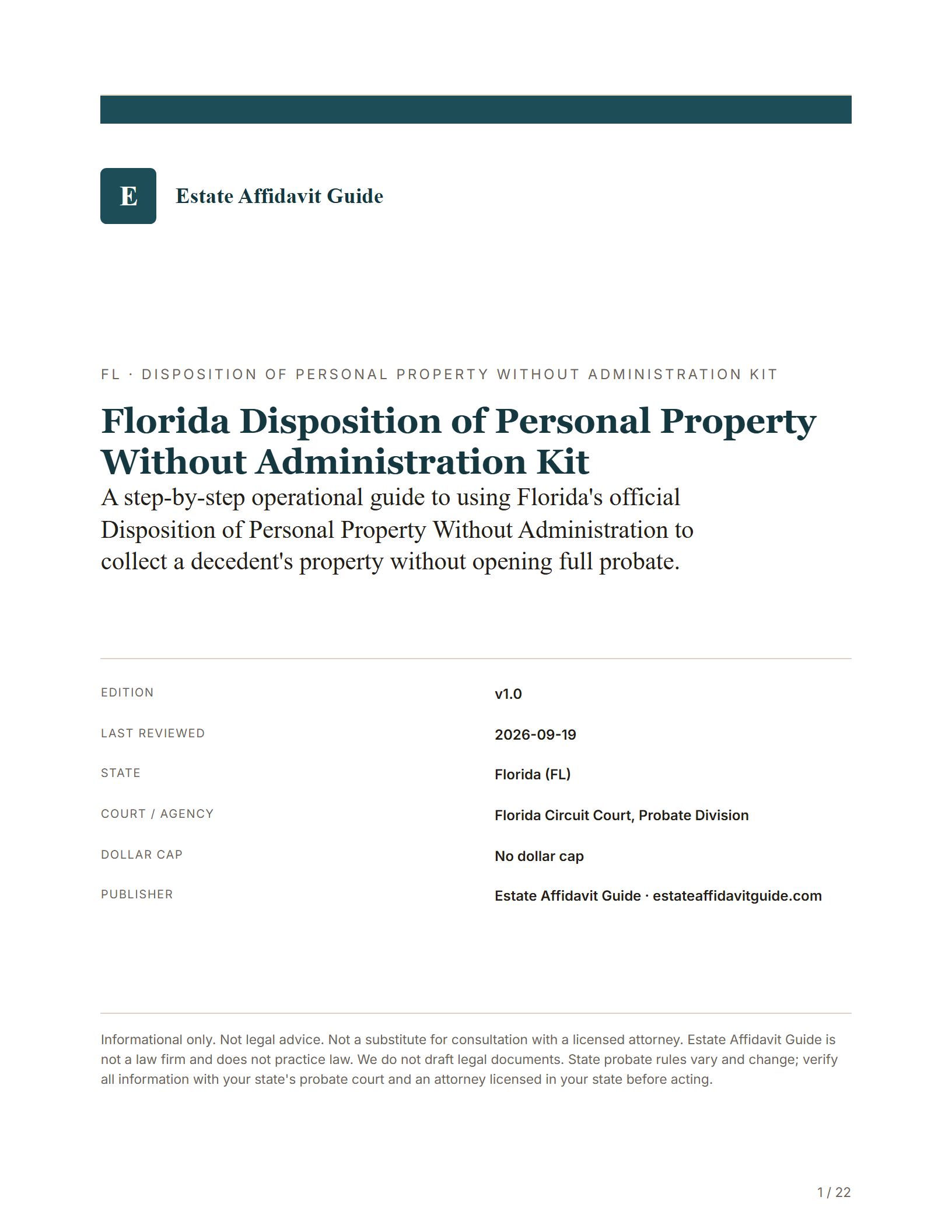
Cover & key facts
Version, last-reviewed date, the statutory cap, and the disclaimer — all on page 1.
View page -
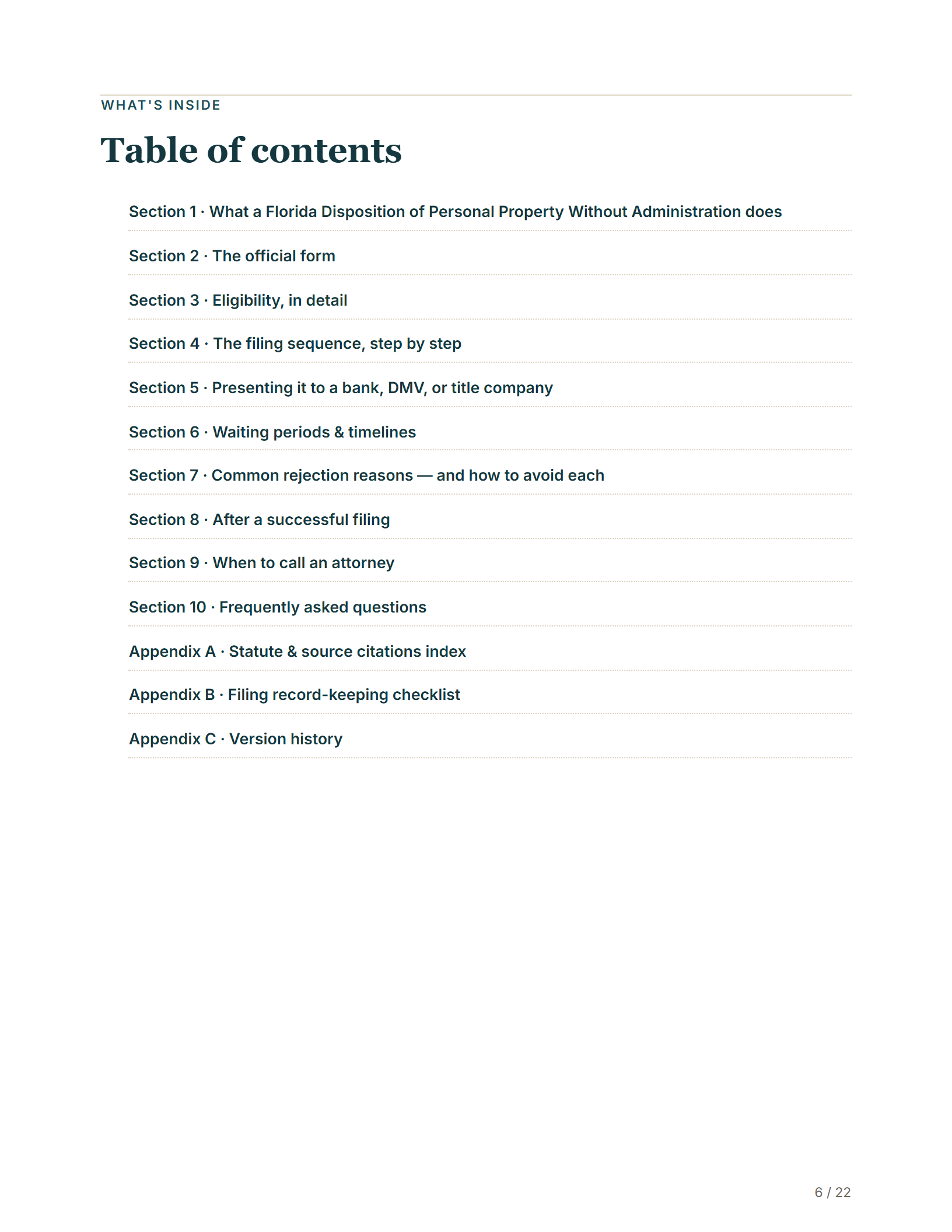
Table of contents
Every section in the order you'll use it — the eligibility check, the form walkthrough, and the bank-refusal script.
View page -
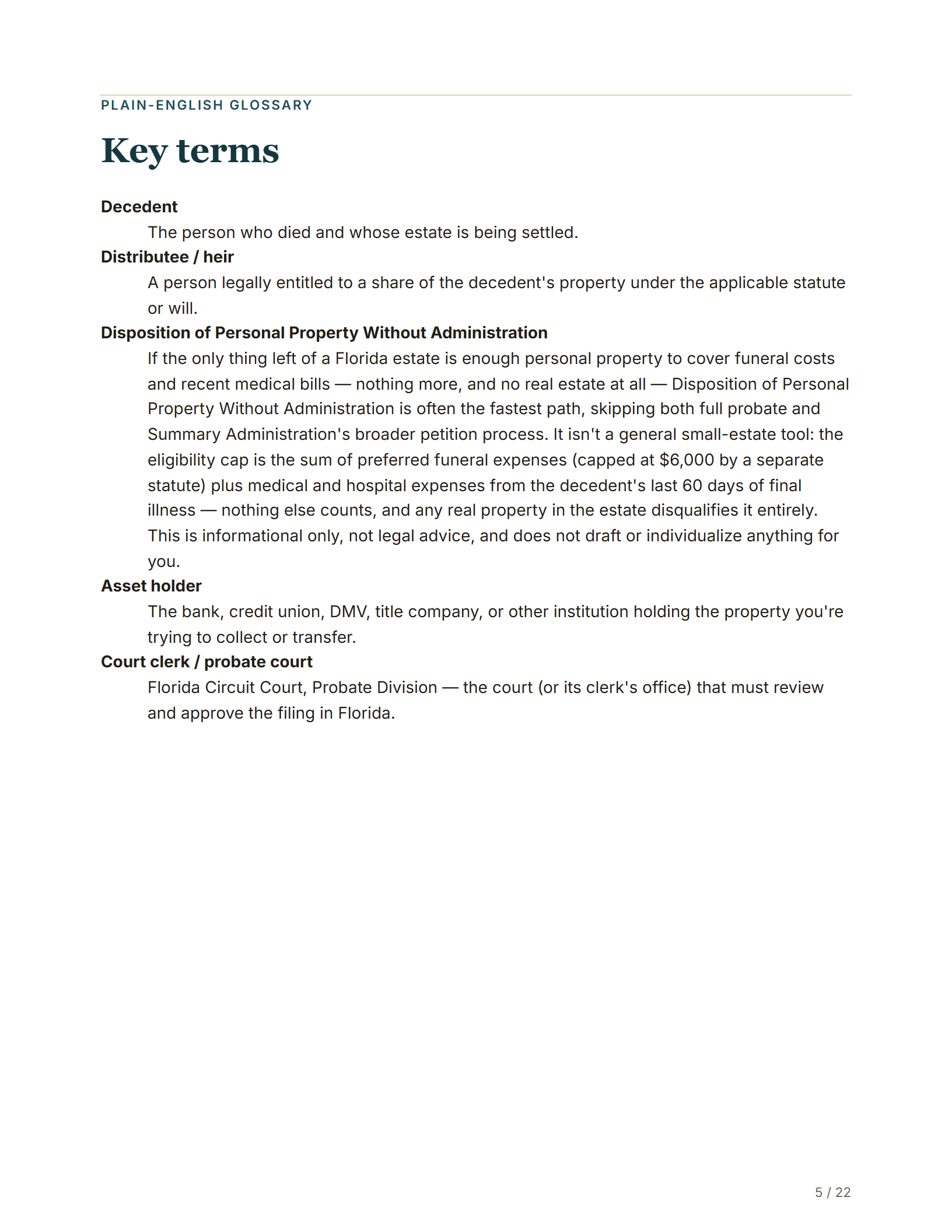
Plain-English glossary
Key terms translated for a non-attorney reader. The vocabulary the rest of the kit assumes.
View page -
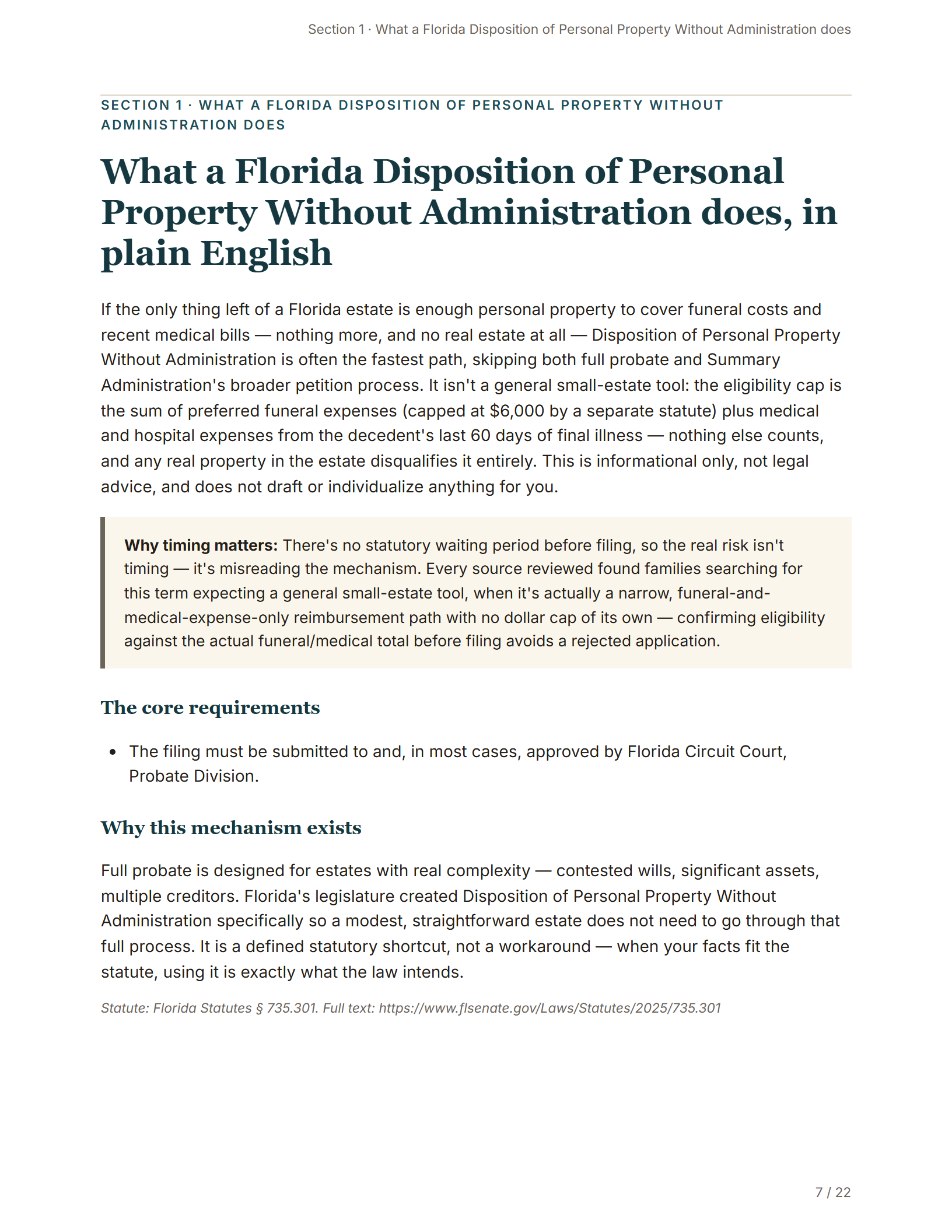
What it does, in plain English
The mechanism explained in plain language, cited to the statute, with your state's exact dollar cap built in.
View page -
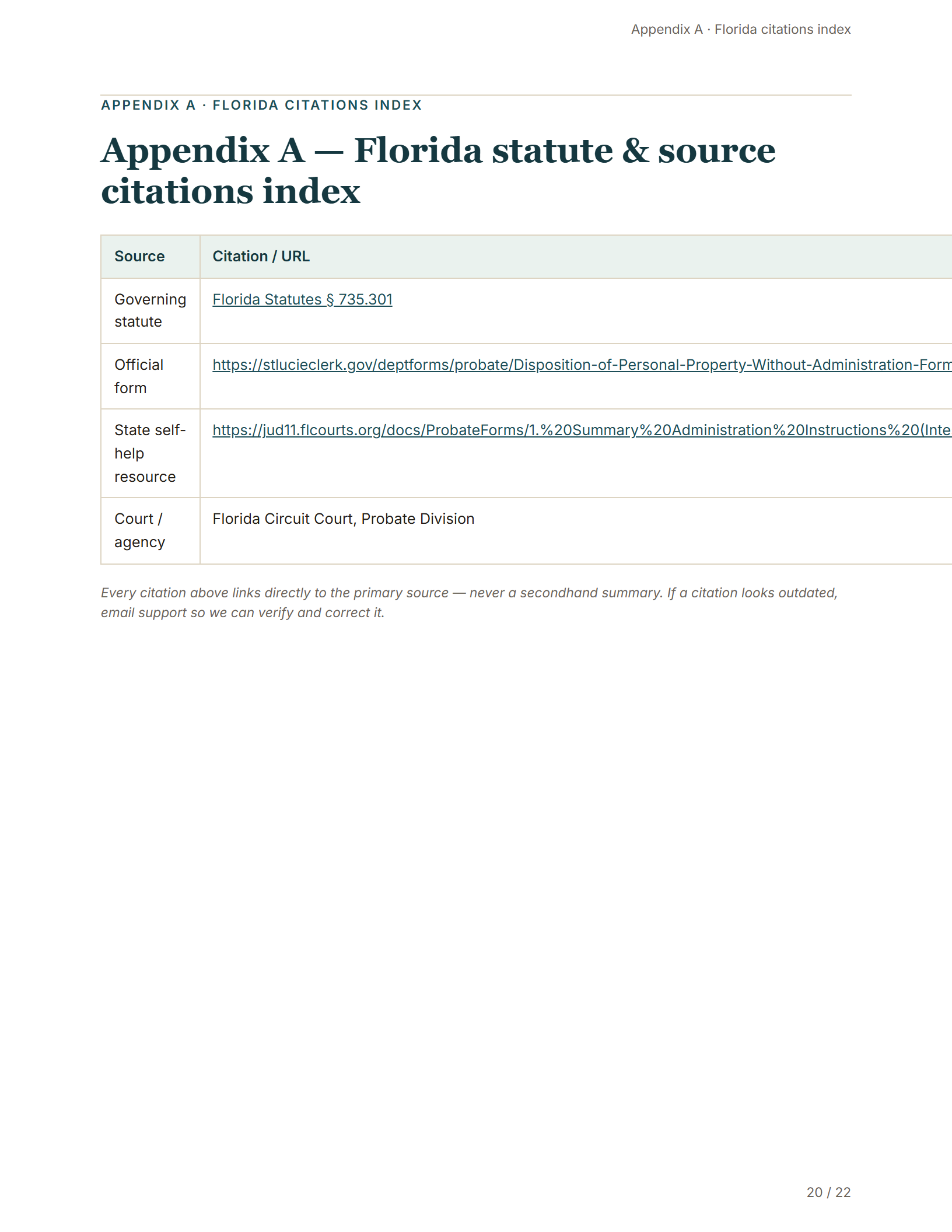
Citations index
Every operational claim sourced to the actual statute or official court/agency publication.
View page
Print-friendly, readable on a phone or tablet, and designed to be taken to the bank or clerk. Every operational claim cites the actual statute or official publication.
How this compares
Yes — Florida's own form is free (that's the Free state form column below). The $37 is for everything the free form leaves you to work out alone: the eligibility check, the filing sequence, and what to do when a bank, DMV, or clerk pushes back.
| This kit | Probate attorney | Free state form | Doing nothing | |
|---|---|---|---|---|
| Cost | $37 | $1,500–4,200+ | $0 | Eventually full probate, if the estate is never settled |
| Time to filed | Same week to prepare; court approval timing varies by county | 2–6 weeks | If you can decode it alone | Not until you act |
| Bank/DMV/clerk pushback script | Yes | Sometimes | No | n/a |
| Statute citations | Yes | n/a | n/a | n/a |
| Delivery time | Instant download | After consult + retainer | Instant | n/a |
Attorney costs reflect typical Florida probate-attorney retainers for this kind of filing.
The most-searched sticking point
What to do when a bank, DMV, or clerk pushes back
A facially valid filing still gets rejected on the first try more often than it should — usually because front-line staff have never processed one before, not because anything is actually wrong. This is the single biggest gap in every free state resource: none of them tell you what to actually say. The kit's Section 5 gives you the exact script and citation for each of these:
- Bank or asset holder asks for more than the court's letter of authorization
- The claimed funeral or medical expenses can't be documented
Each one has a specific script and statutory citation behind it — not just "you're right, they're wrong," but exactly what to say and what document to hand over. That's in the kit.
If a bank, DMV, title company, or court clerk rejects your filing for a reason traceable to following this kit, you get a full refund.
Email the stated rejection reason to support@estateaffidavitguide.com within 30 days of purchase and we refund the full purchase price within one business day. No phone tag, no forms, no fight. Not covered: an estate that turns out to be over the dollar limit, a dispute among heirs, or a missing document unrelated to the filing itself. Changed your mind for any other reason? You have 7 days, no questions asked. Full refund policy.
Avoid these
3 common reasons filings get rejected
The estate includes any real property
Nonexempt personal property exceeds the funeral-plus-medical expense total
Claimed expenses fall outside the two allowed categories
Before you present the Florida Disposition of Personal Property Without Administration
Most rejected-on-the-first-try filings are a front-line-staff problem, not an eligibility problem. This free one-pager has what to bring and what to say the first time you hand it to a bank, DMV, or clerk — emailed now. We'll also send a few short follow-ups over the next few weeks (why most pushback is unfamiliarity not law, the exact citation to point to, when to call an attorney) — then we stop. No ongoing newsletter.
Questions
Frequently asked questions
Does Disposition Without Administration work for a house or other real estate?
What's the actual dollar limit for Disposition Without Administration in Florida?
Is Disposition Without Administration the same as Florida's small estate affidavit?
Who can apply for Disposition Without Administration?
Which Florida mechanism applies to my situation — Summary Administration or Disposition Without Administration?
Does Florida have a 'small estate affidavit' like other states?
Ready to start?
$37, one time. Instant download. Money-back if your filing is rejected for a reason traceable to following the kit, or for any other reason within 7 days.
No waiting room, no retainer. Most of the remaining delay families hit is an avoidable rejection or a second trip back to the same bank, DMV, or clerk — this kit is built to help you avoid both on the first visit.
One last step — confirm below and it's instant from there.
Secure checkout by Stripe · Instant download · Money-back guarantee
Want a sibling or co-executor caught up? Send them what you just read.
Not ready to buy yet?
5 short, plain-English emails over the following weeks — the eligibility math, the disposition of personal property without administration presentation moment, why most rejections are paperwork not eligibility, and when to call an attorney instead. Then we stop. No ongoing newsletter, no sales list. Unsubscribe anytime.
Primary sources
State sources
Every claim here cites the actual statute or an official publication — see them
- Statute: Florida Statutes § 735.301 . The primary source behind every requirement, cap, and deadline described above.
- Official form: Official Disposition of Personal Property Without Administration form Unlike Summary Administration, Florida courts have not promulgated one statewide fill-in form for this mechanism — county clerks (St. Lucie, Seminole, Charlotte, Brevard, Pinellas, Manatee, and others) each publish their own version of the informal-application packet, all implementing the same statewide § 735.301 requirements. St. Lucie County's packet, linked here, is a verified working example on the county's own .gov domain; your own county clerk's probate division publishes its own version.
- State self-help resource: Florida Circuit Court, Probate Division